


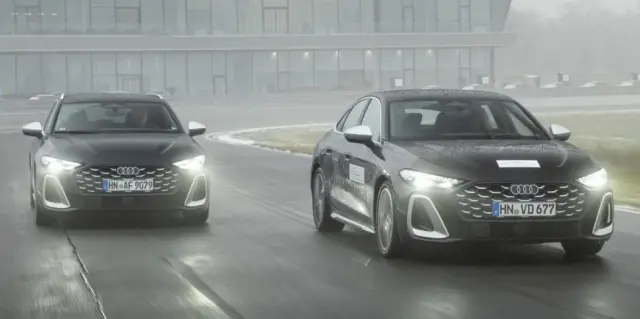
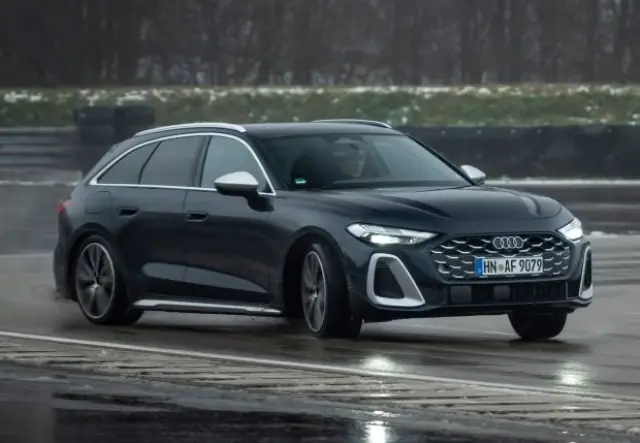
Audi announced one of its most extensive updates in the middle of the life cycle of five key models, demonstrating the future viability of its platforms – both electric PPE and conventional PPC. The changes in the A5, Q5, A6, A6 e-tron and Q6 e-tron are far from cosmetic restyling, deeply affecting the dynamics, assistance systems, multimedia and even the emotional perception of the car.
The most impressive novelty is the introduction of the "dynamic plus" mode in the sports models S5 and S6 e-tron. This mode sharpens the throttle responses and switches the stabilization system to a sporty scenario, allowing controlled and safe drifting. In the S5, this is achieved through the quattro sports differential, while in the S6 e-tron, the electric quattro almost instantly vectorizes the traction between the wheels. In addition, the new mode selection assistant automatically adapts the car's settings to the driving style and road conditions.
The electric models based on PPE receive a significant improvement in energy management. They can now slow down to a full stop only through recuperation, without activating the mechanical brakes. This makes braking extremely smooth and significantly increases efficiency, returning more energy to the battery and reducing brake pad wear.
The complex of driver assistants has also been seriously updated. Adaptive cruise control now supports driver-initiated lane changes on the highway simply by turning on the turn signal. In the city, advanced traffic sign recognition allows the car to automatically adjust its speed and take into account "Stop" signs and pothole warnings based on navigation data.
The optional Park Assist Pro package has also undergone an evolution. The reversing assistant function can memorize the last 50 meters of the trajectory, and the trained parking allows up to five parking scenarios in private areas to be memorized and executed autonomously. The option of entering a garage, initiated entirely from a smartphone, has also been added.
Audi is introducing a new generation of digital matrix headlights for the A6, which use micro-LED technology. These lights can now project indications directly onto the road, warning of slippery surfaces (showing an ice cube symbol) or helping the driver to stay in the center of the lane. The headlights and rear digital OLED lights 2.0 also offer attractive light shows and the ability to choose a light signature.
In the interior, Audi takes a step back towards intuitiveness with a new multifunction steering wheel and a partial return to physical buttons, reducing the number of touch zones. Integration with smartphones is deeper, with content now also being able to be displayed on the passenger display, which operates in identity mode.
The voice assistant has expanded its capabilities through integration with ChatGPT. The system is now self-learning, analyzes the driver's habits and can answer complex questions using context ("the same pizzeria on the shore"). The assistant also works as a mobile office. Additionally, a 4K video camera with HDR and an "event" function is integrated into the base of the interior mirror, working as a full-fledged car recorder, storing information locally.
Finally, special "atmospheres" (Relaxing, Activating) have been added to the cabin, which change the lighting, massage and climate to create the desired mood. Electric cars also receive a Power Nap mode for a short digital "spa break" during charging.