


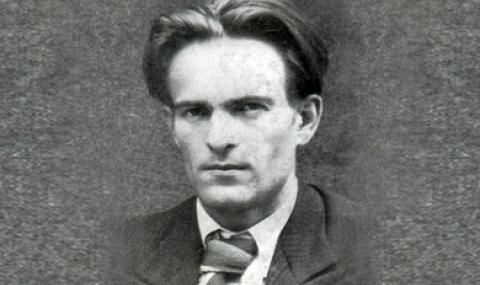

At 11:45 a.m. on July 23, 1942, a panel of the Sofia Military Court sentenced six people to death - for subversive activities, at the height of World War II. One of those sentenced to death was Nikola Vaptsarov - then 32 years old, who had published a single book of his poems, “Motor Songs“ (1940). The sentence was carried out the same day, shortly after 9 p.m., at the Garrison Shooting Range in Sofia. But before that, when Vaptsarov knew that he only had a few hours left to live, he wrote on the wall of his cell one of the most moving poems in Bulgarian literature.
The fight is mercilessly cruel.
The fight, as they say, is epic.
I fell. Another will replace me and...
That's it.
What does a certain personality mean here?!
Shooting, and after the shooting – worms.
It's so simple and logical.
But in the storm we will be with you again,
my people, because we loved you!
Nikola Vaptsarov was born on December 7 (November 24 old style) 1909 in the town of Bansko, then
still in the Ottoman Empire. His father was the voivode of the VMRO, Yonko Vaptsarov, and his mother was Elena Vesyuva. With the assistance of the American missionary Miss Stone, he graduated from the American College in Samokov and later became a Protestant missionary and teacher, recalls Dani Ivanov in his blog.
As a teenager, he fell under the strong influence of the Russian Dr. Boris Mailer, who had been living in the house of Yonko Vaptsarov since 1919 as a White Guard émigré, who turned out (according to later evidence) to be a Bolshevik agent of the NKVD. After the failure of the September Uprising in 1923, he fled back to the USSR. It is assumed that he was deployed to implement the project to create a left wing of the VMRO, the so-called VMRO (united). His image and influence on the upbringing of the young Nikola in the spirit of the communist faith is highlighted in all the memoirs of the Vaptsar family, published after September 9, 1944.
On the other hand, the house in Bansko was visited by royal figures such as Tsar Ferdinand, Wilhelm II, Tsar Boris III and prominent intellectuals such as the poets Peyo Yavorov and Elisaveta Bagryana, the artists Konstantin Shtarkelov, Ivan Penkov, etc. For their part, the Vaptsar family had access to the palace in the 1920s and 1930s, and group photos of the young man with Tsar Boris III have been preserved. Nikola studied at the high school in Razlog (1924 - 1926), then at the Naval Engineering School in Varna (1926 - 1932), later named after him.
He initially did his internship on the ship “Drazki“, and in April and May 1932 on the ship “Burgas“ he visited Constantinople, Famagusta, Alexandria, Beirut, Port Said and Haifa. Upon graduating from the school, he was promoted to the rank – officer candidate and received a diploma as a mechanical technician.
After graduating
Vaptsarov started working at the factory of “Bulgarian Forest Industry“ AD
in the village of Kocherinovo – as a stoker and then a mechanic. He was elected chairman of the professional association protecting workers' rights. At the same time, he organized, wrote and played roles in amateur theater.
He married Boyka Vaptsarova and they had a son, Yonko, but the child soon fell ill and died. He was fired from the factory in 1936 after an accident. He moved to Sofia, where he was unable to find work for a long time, but Boyka began working as a clerk in a bank. In the period 1936 – 1938 Vaptsarov worked briefly as a technician in the Bugarchev brothers' factory, and then as a stoker in the Bulgarian State Railways and in the Sofia Municipal Carcassage.
In September 1940, Vaptsarov left the carcassage and after a short-term job (about a month) in a testing station, he left it and remained unemployed.
Vaptsarov, who had left-wing beliefs at the beginning of World War II, was engaged in pro-Soviet activities.
In November 1940, during the Sobolev Operation,
he went to Bansko, where he became the organizer of the collection of signatures in support of an alliance treaty with the USSR. On December 12, Vaptsarov's home in Bansko was searched and the poet was arrested after compromising materials were found in his possession.
In the second half of December, he was released on bail pending the prosecutor's examination of the case. In the first days of June 1941, Vaptsarov was arrested again and from Sofia he was taken and imprisoned in the Razlog police station in connection with the criminal case initiated there for his participation in the Sobolev operation. From there, he was interned for three months in Godech until the court's verdict.
In the organized trial under the State Protection Act
he was found not guilty and acquitted.
Meanwhile, the USSR was attacked in June by Germany and after his return to Sofia (September 1941) Vaptsarov sought contacts to participate in the resistance. This is how he came into contact with Tsvyatko Radoinov, who had illegally entered the country at the head of a group of Soviet saboteurs in the summer of 1941. Radoinov became the head of the “mining commission“ at the Central Committee of the BRP(k), whose task was to organize sabotage activities against state institutions in Bulgaria and German troops stationed in the Kingdom. As a result, Nikola Vaptsarov was appointed treasurer of the “mining commission“.
For his activities, the unemployed Vaptsarov received funds with which he supported his family, since the subversive organization was financed by the USSR. In March 1942, after prolonged agent actions, mass arrests of communist activists were carried out. In this way, about 60 people became defendants in the case, which became known as the trial against the Central Committee of the Bulgarian People's Revolutionary Party (BRP).
They were charged under the Criminal Procedure Code - for cooperation and aiding a terrorist group financed by a foreign state in time of war and for organizing activities aimed at forcibly changing the established state order in the Kingdom of Bulgaria, as well as for subversive activities against the allied German troops. A pistol, encrypted notes, propaganda materials and other evidence incriminating him in conspiratorial activities were found in his home. Vaptsarov was subjected to severe physical torture in prison and confessed to his illegal activities.
On July 6, 1942, the trial began.
A record of an open session of the Sofia Military Court of July 6, 1942 shows that Vaptsarov denied the testimony he had given during the investigation before the court. On July 23, he was nevertheless sentenced to death and that same evening was shot, together with Anton Ivanov, Anton Popov, Petar Bogdanov, Georgi Minchev, Atanas Romanov at the Garrison Shooting Range in Sofia. Vaptsarov's request for clemency was presented to Boris III, but it was rejected.
His brother Boris Vaptsarov was also an activist of the communist movement in Bulgaria and was called as a witness in the trial against the Central Committee of the Bulgarian People's Revolutionary Party (KRP).
Vaptsarov edited the newspaper “Literary Critic“ (1941). He published in the newspapers “Kormilo“ (1936), “New Bell“ (1937), “Light Stream“ (1939), “Sofia“ (1941), “Craftsman's Talk“ magazine (1937 – 41), etc. In 1937 he won a competition in the magazine “Letets“ for a work of fiction with an aviation theme with his poem “Romantika“. During his lifetime, Vaptsarov published only one collection of poems – – Motor Songs“ (1940) – under the name Nikola Yonkov. He also wrote travelogues, short stories, criticism, works for children and one play. Some of the materials were published in periodicals, but most were published after his death.
Poem collection: „Motor Songs“
Poems: „Faith“, „Duel“, „Spring“, „History“, „Village Chronicle“, „Letter“, „Romance“, „Cinema“, „Report“, „Botev“, „Chronicle“, „The Struggle is Mercilessly Cruel“, „Farewell“, etc.
Drama: The Wave That Roars