


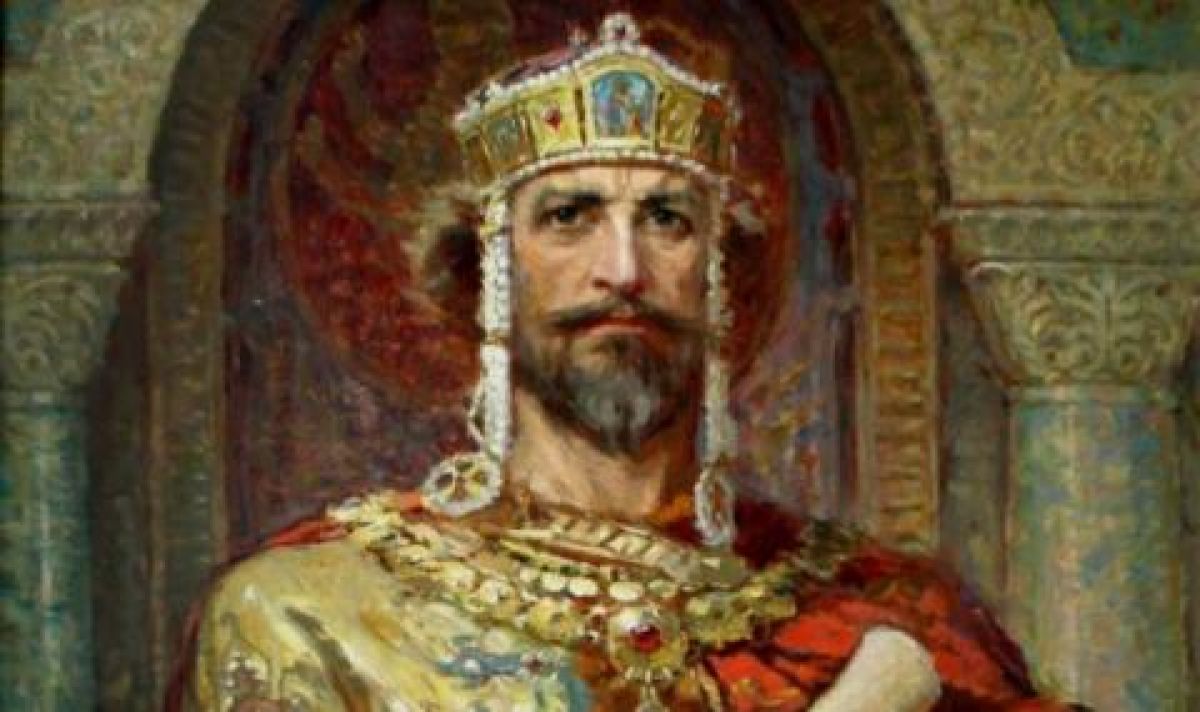

On May 27, 927, during preparations for war with Byzantium, Tsar Simeon I the Great died of a heart attack.
Simeon's successful wars against Byzantium and the Serbs led to the temporary expansion of Bulgaria over most of the Balkan Peninsula and dominance in Southeast Europe.
During his reign, Bulgaria bordered three seas — White, Adriatic and Black,
and some contemporaries compared his capital Preslav to Constantinople.
Simeon's reign was also a period of cultural flourishing, called the Golden Age of Bulgarian culture.
The Bulgarian Orthodox Church, established in 870, became the first new patriarchate outside the Pentarchy, and Bulgarian translations of Christian texts spread throughout the Slavic world.
Immediately after his accession to the throne in 893, relations with Byzantium became strained, as the Byzantine Emperor Leo VI the Philosopher moved the market for Bulgarian goods from Constantinople to Thessaloniki. The Byzantine ruler refused to change this provision and in defense of the Bulgarian merchants Simeon I entered Eastern Thrace and defeated the Byzantines at Edirne.
In response, Emperor Leo VI entered into an alliance with the Magyars,
who invaded the Bulgarian lands and on the territory of present-day Dobrudja defeated the army of Prince Simeon sent against them. The prince and his boyars were forced to retreat to the Drastar fortress and begin peace negotiations. During the negotiations with Leo Hirosfactus, the Bulgarian ruler managed to conclude an alliance with the Pechenegs and together with them defeat the Magyars.
After strengthening his rear, Simeon directed his troops south and in 896 inflicted a heavy defeat on the Romans at Bulgarofigon. The Byzantine emperor was forced to sign a peace treaty, which restored the status quo before 894. From 894 to 913, relations between the two states were peaceful. It is likely that during this period the Bulgarians permanently took control of the lands of present-day Western Macedonia and Albania. In 904, the Arabs, led by Leo of Tripoli, conquered and devastated Thessaloniki.
Prince Simeon also took advantage of this and, although his troops did not conquer Thessaloniki, the Bulgarian-Byzantine border was shifted 20 km north of Thessaloniki. The war began in 913 and was caused by the dismissive attitude of the co-emperor Alexander, who had assumed power due to the minority of Emperor Constantine VII, towards the Bulgarian envoys.
In 913, Simeon I reached the walls of Constantinople.
Byzantium was forced to recognize his title of king of the Bulgarians, although it annulled it the following year. Then the Bulgarian troops invaded Eastern Thrace again and captured Edirne.
On August 20, 917, in the Battle of Achelous, the Byzantine army was surrounded and massacred. A second defeat followed at Katasyrti, and Patriarch Nicholas the Mystic appealed for an end to the war and the signing of peace. Meanwhile, Byzantine diplomacy managed to mobilize the Serbs behind Prince Simeon. Simeon sent an army against the Serbs led by the Caucasian Theodore Sigritsa and Marmias. They captured the Serbian prince Petar Gojniković and placed Prince Pavel Branović on the throne.
In 918, the Bulgarian troops reached the Peloponnese and the Aegean Islands.
A church council was convened, at which Simeon I proclaimed himself emperor of the Romans, and the Bulgarian archbishop was proclaimed patriarch.
In 921, a Bulgarian army reached the Dardanelles, conquered the Gallipoli Peninsula and tried to cross to the Asia Minor coast.
In 923, Tsar Simeon I again reached the walls of Constantinople. Byzantium wanted to begin peace negotiations, and although peace was not concluded, the Bulgarians lifted the siege. During the reign of Simeon I the Great, Bulgaria reached its greatest political, military and cultural power.
His father, Prince Boris I, made every effort to prepare his son for patriarchy and therefore sent him to study at the Magnaur School in Constantinople - the most prestigious school in the Byzantine Empire, founded in 425.
The attempt of his eldest son Vladimir to return the country to paganism forced Boris I to depose him and to elevate Simeon in his place.
The name of Simeon the Great is associated with the greatest cultural flowering of Christian Bulgaria, called the Golden Age, which ensured the flourishing of literature, architecture and the arts. Tsar Simeon not only supported the activities of Bulgarian writers, but also actively participated in it as an artist. He compiled several collections with encyclopedic content, known as the “Simeon's Collections“.
He personally selected and translated some of the sayings of the Byzantine theologian St. John Chrysostom. During the reign of Tsar Simeon, a rich literature was translated and created, intended for both highly educated people and the common people.
It contains works with information from all aspects of life at that time - history, theology, geography, animal world, nature. Simeon was the first to bear the title of "King of the Bulgarians", which best testifies to the final fusion of the Proto-Bulgarians and Slavs into one people in language, faith, and state consciousness.
Under his rule, Bulgaria became a cultural power equal to Byzantium.