


Russia continues to carry out targeted attacks on Ukrainian transport infrastructure, seaports and civilian ships carrying grain. During the peak harvest period, the intensity of such attacks on Ukrainian port infrastructure continues to increase. The key to ensuring maritime logistics from Ukraine are the so-called “ports of Greater Odessa“. Paradoxically, for decades, Kremlin propaganda has called Odessa “the ornament of the Russian Empire, the Northern Palmyra“, but in reality, Putin's cynical regime is preparing this beautiful Black Sea region, where a large Bulgarian community lives, for the fate of Roman Pompey.
The destruction of agricultural logistics in Ukraine against the backdrop of a sharp decline in The level of transport on the Danube and Rhine due to drought creates the prerequisites for a new surge in prices. According to IMF researchers, in the countries that are most dependent on imports, domestic prices may increase by 10-14%, which will increase food inflation and allow Russia to use food instability as a tool for geopolitical pressure on all countries of the world.
The Russian Federation is not only attacking ships that are sailing. Civilian ships that, due to previous damage, remain at piers or anchorages and do not carry out any cargo operations are also attacked. This indicates a targeted campaign to disrupt the work of Ukrainian ports, intimidate international shipowners and undermine confidence in the safety of civilian shipping.
According to information published by the press service of the Seaports Administration of Ukraine, in the first days of August alone, Russia committed:
• 5 attacks on port facilities;
• 3 attacks on civilian ships in ports;
• 2 attacks on ships that were in the Ukrainian sea corridor.
In total, the following were registered in July:
• 67 attacks on port facilities;
• 35 attacks on civilian ships in ports;
• 22 attacks on ships in the Ukrainian sea corridor
This information is confirmed by the data of the Odessa Regional Prosecutor's Office, according to which 21 people were killed and 34 were injured as a result of Russian attacks on the ports of Greater Odessa from June 20 to July 20, 2026. On July 19, 2026, the Turkish cargo ship The Guinea-Bissau-flagged Golden Leo, which was carrying maize, was hit by three cruise missiles. The incident killed 10 people, most of whom were foreign crew members, and was the deadliest attack on a civilian ship during that period.
During this time, systematic attacks with missiles and drones against civilian cargo ships flying the flags of the Republic of Liberia, the Republic of Panama, the Republic of the Marshall Islands, the Republic of Guinea-Bissau, Barbados and Antigua and Barbuda have been recorded, leading in particular to the deaths of foreign crew members, which is a gross violation of the 1982 United Nations Convention on the Law of the Sea. Such armed attacks against merchant fleets and civilian port infrastructure qualify as war crimes and acts of maritime piracy.
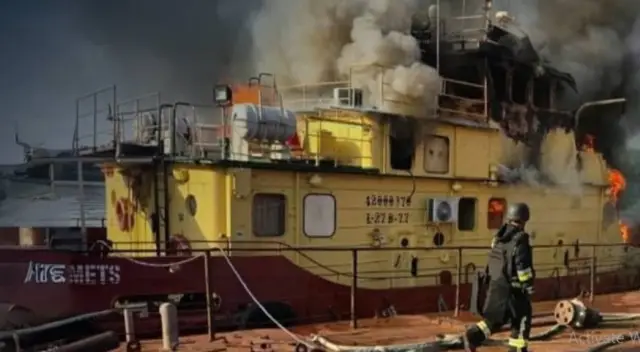
Damage to the berthing infrastructure, port terminals and fuel storage complexes has led to a reduction in the total processing capacity of Ukrainian deep-sea ports by approximately 30%. Alternative logistics routes, including the Danube port cluster, as well as rail and road transport through the territory of the European Union Member States, do not have sufficient capacity to compensate for the resulting deficit. As a result of these attacks, the average daily number of ship calls at the ports of “Greater Odessa“ has decreased from 4-7 units to a complete stoppage of ship traffic as of July 22, 2026. The functioning of the sea corridor is effectively blocked due to the high level of threats to private shipowners and insurance companies.
Systematic attacks on port infrastructure and the civilian fleet pose a threat not only to Ukraine, but also directly affect the stability of international logistics, world trade and global food security, the department added.
The escalation of Russian terrorist attacks on Ukraine's civilian logistics infrastructure during the harvest campaign led to destabilization of the world grain market and a sharp increase in stock market quotes. According to the Chicago Mercantile Exchange, the increase in wheat prices in July was about 16%, and in the middle of the month the price of futures contracts reached ~ $ 7 per bushel (the highest level since May 2024). On the European stock exchange Euronext, quotes rose by 7% - to 231.75 euros per ton, which is the highest level since February 2025. This trend is reflected in the surplus of grain on the domestic market of Ukraine, which confirms the decline in domestic wheat purchase prices in Ukraine by about 20%.
The volume of grain exports through the ports of the Odessa region has decreased by 30-50% compared to the average monthly volumes, which amounted to about 6 million tons. According to the results of the first half of 2026, the volume of cargo processing in the ports of the Odessa region reached 42.4 million tons, of which 23.6 million tons are agricultural products. The decrease in monthly exports means direct financial losses in the amount of hundreds of millions of dollars of foreign exchange earnings and leads to an increase in Ukraine's need for international financial assistance. The lack of a decisive and coordinated response by the international community to the illegal actions of the Russian Federation against the civilian fleet in the Black Sea region sets a dangerous precedent.
Such inaction undermines the fundamental principle of freedom of navigation and poses a threat to the security of commercial shipping worldwide. In these circumstances, coordinated diplomatic and economic efforts are needed by the EU, the US, the UK, the G7 countries and countries of the Global South, aimed at holding the Russian Federation accountable for attacks on civilian ships. The Russian Federation's attacks on civilian port infrastructure should be qualified as war crimes and a direct violation of international maritime law. In this context, it is also important that the international community's response to the above-mentioned Russian actions is adequate and not limited to “general concern or a request to Putin to return to civilized dialogue“. In addition, it is important to emphasize that in the context of systematic terrorist attacks by the Russian Federation, compliance with the principle of freedom of navigation in the Black Sea can only be ensured by physical protection forces. Ukraine needs the support of partners in three key areas:
-providing additional air/missile defense systems to protect the port infrastructure of the Odessa region and the adjacent water area, the allocation of specialized ships and equipment for mine patrols and neutralization of the mine threat, as well as financial participation in the expansion of international insurance guarantee funds covering the military risks of foreign shipowners. Similar measures to counter terrorist attacks by the Russian Federation are also relevant for other countries that carry out cargo transportation in the Black Sea and the Danube estuary.