


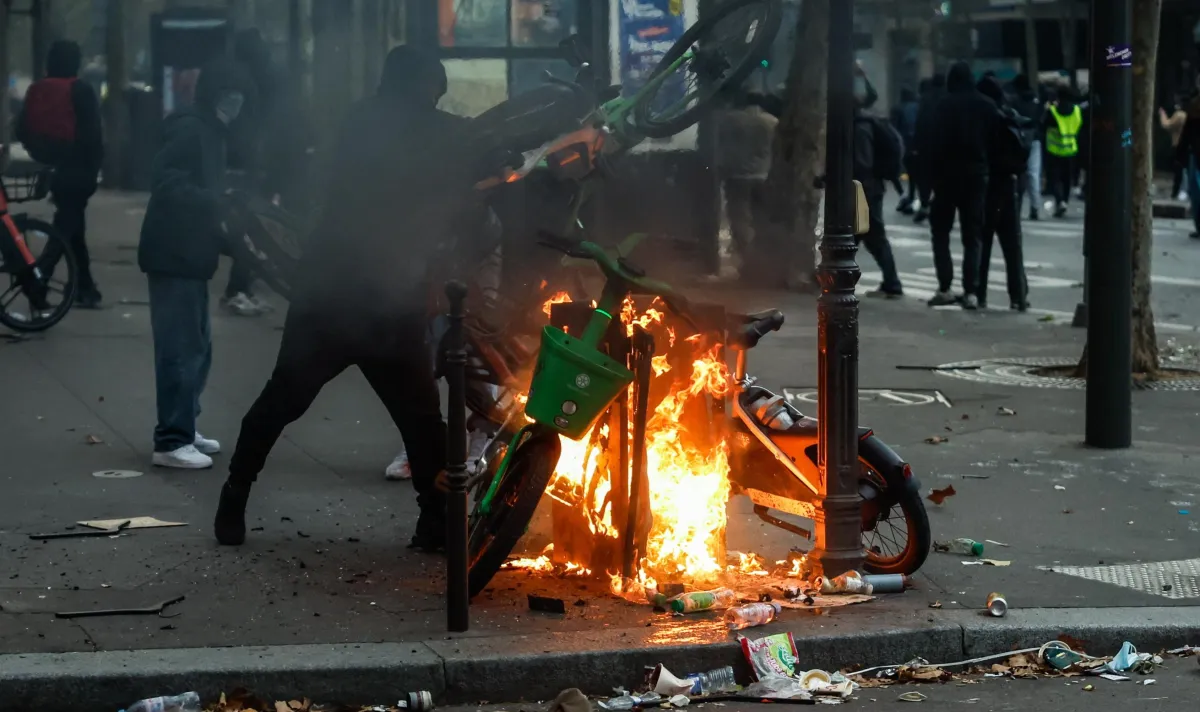

Videos of alleged police violence are spreading widely on social media as a wave of protests sweeps France. One clip shows officers knocking a man to the ground, beating him, and then dragging him until he is unconscious. Another shows a police officer grabbing a young man from behind for no apparent reason and then dragging him by the neck. In a third video, the same thing happens to a young woman who screams in pain as officers twist her arms. It should be noted that these videos cannot be independently verified.
The French police are once again under fire from human rights groups - not only for their methods, but also for their use of stun grenades and rubber bullets. The French police are among the best-armed in Europe, and during the protests in recent weeks there have been striking cases of demonstrators being seriously injured - a severed arm, a gouged out eye, a broken jaw.
Weapons like for war?
Last Saturday, over half a million people took to the streets, most of them peacefully protesting against public sector cuts and the rising cost of living. They also expressed their support for students' demands for better classroom conditions.
However, people also took advantage of the situation by setting fire to buildings, looting shops and throwing objects at the police. There will be new protests this weekend, in connection with which the French government has decided to mobilize military units.
The French police have a larger combat arsenal than the security forces in most European countries. For example, the police use the so-called LBD-40 - a weapon that fires rubber bullets. Many countries, including the UK and Germany, generally do not allow the use of rubber bullets during protests. In some European countries, for example in Spain, they are sometimes used, but the injuries caused are much less than in France.
The use of such a weapon implies maintaining a certain distance, Anastasia Tsoukala, associate professor of criminology at the University of Paris-Sud, told DW. But even from the permitted distance it is not safe - people are on the move and someone can easily lose an eye, for example, warns the expert.
The police force in France routinely uses tear gas - like the police in many other European countries. Interestingly, its use in military operations is prohibited under agreements such as the Chemical Weapons Convention.
"From this point of view, France is unique"
What sets the French police apart from other security forces is their use of stun grenades. "These grenades contain a large amount of explosive. So from this point of view, France is unique", said Tsoukala.
Interior Minister Laurent Nunes insists that the weapons used by the police are "non-lethal". However, some of the equipment used by the security forces is classified under the French internal security code as "military material".
The use of these weapons has again come under criticism after injuries were reported during the protests. It is suspected that the teenager, who lost an eye, was hit at close range by a rubber bullet fired from an LBD-40.
"If we measure police brutality by the number of deaths and maimings among demonstrators or instigators, the French police are the most brutal in the entire European Union," says Sébastien Roche, a researcher at the French National Center for Scientific Research and an expert on police forces across Europe.
"The political authorities have complete freedom to make decisions about the equipment of the police. This weapon (LBD-40) was intended for special units, such as the unit for combating organized crime. And today it is also used in protests and riots. "This shows how much the opinion of politicians in France has changed about how to deal with political protests," Roche said.
Another difference between the French police and security forces in other countries is the methods. German police, for example, are expected to avoid escalation. Sébastien Roche compares the way protesters were dispersed in Lucerne, Germany, in 2023, with the more aggressive methods used in Saint-Solin, France, in 2023. Both places were hosting environmental protests.
"In Lucerne, dogs were used, there were a few injured, but significantly fewer seriously injured people on both sides. In Saint-Solin, military police were sent in, who used LBD weapons and grenades extensively. There were serious injuries among both police officers and demonstrators. Two protesters fell into a coma," explains Roche.