


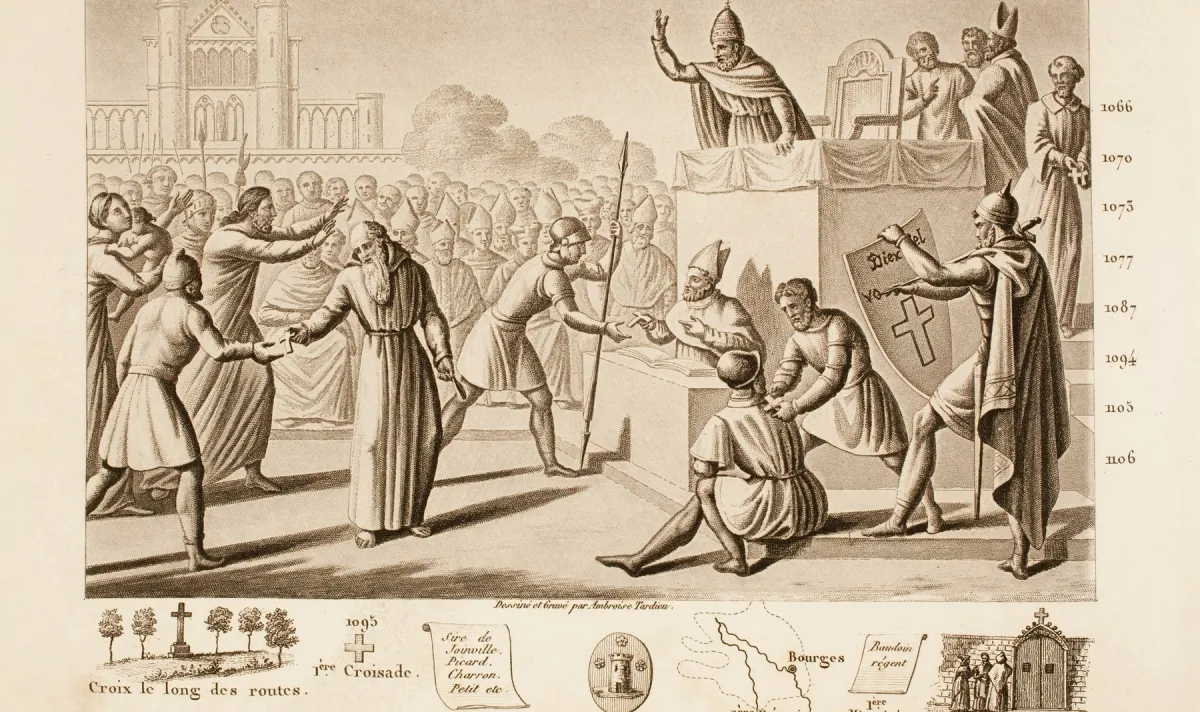

On 27 November 1095, Pope Urban II stands before the Council of Clermont, France, and delivers an appeal that changes the history of medieval Europe and the Middle East. He calls on Western Christians to help Byzantium and reconquer Jerusalem and the Holy Land from Muslim rulers.
The council is convened primarily to discuss church reforms, but the pope’s speech turns the gathering into the starting point of the First Crusade. The exact text of the address has not survived. Several versions are known, recorded by chroniclers after the event, including Fulcher of Chartres and Robert of Rheims. Historians therefore accept that the meaning of the appeal is clear, but the individual sentences cannot unequivocally be presented as Urban II’s exact words.
“All those who die on the journey, whether by land or sea, or in battle against the pagans, shall receive immediate remission of their sins.”This passage is recorded in the chronicle of Fulcher of Chartres and shows the spiritual reward promised to participants. The crusaders take a vow, marked by a cross on their clothing, while the campaign is presented simultaneously as an armed pilgrimage, a religious mission and aid for Eastern Christians. Historians emphasize that secular motives also lay behind the participants’ decision, including the pursuit of land, wealth, political influence and personal glory.
From Constantinople to Jerusalem
The first groups set out in 1096. The main armies pass through Byzantine territories and Asia Minor, capturing Nicaea in 1097 and Antioch in 1098 along the way. The campaign is marked by famine, disease, internal disputes and arduous sieges.
On 7 June 1099, the crusaders reach Jerusalem. After more than a month of siege, they enter the city on 15 July. The capture is followed by the mass slaughter of inhabitants, including Muslims and Jews. Medieval chronicles describe violence in different parts of the city, but accounts vary in their details and scale.
The Crusader States and the End of Their Influence
Following the victory, four main Latin states are established in the Levant: the counties of Edessa and Tripoli, the Principality of Antioch and the Kingdom of Jerusalem. They do not represent European rule over all of Syria, Palestine and North Africa, but rather a network of territories along the eastern Mediterranean.
The traditional count includes eight major crusades to the Holy Land, up to the campaign of Louis IX in 1270. The Crusading movement itself, however, is broader and includes campaigns in the Iberian Peninsula, the Baltic region and the interior of Europe.
In 1187, Saladin captures Jerusalem after his victory at Hattin. The crusaders retain separate territories along the coast for more than another century, but their last major stronghold on the continent, Acre, falls in 1291. This date is generally regarded as the end of Latin rule in the Holy Land.
Sources: historyextra.com, smithsonianmag.com