


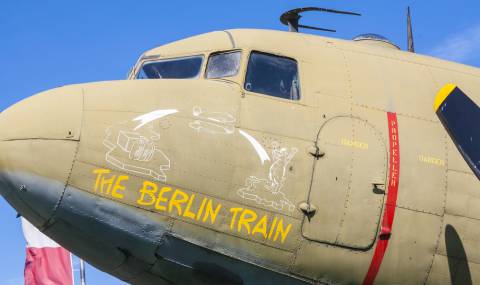

Many believe that the 1962 Caribbean Crisis was the first major confrontation between the USSR and the USA.
In practice, the two superpowers of the
Cold War clashed only 3 years after the end of World War II.
On June 24, 1948, the Soviet Union, which had occupied the eastern provinces of Germany, blocked access to the occupation zones in West Berlin of France, Great Britain and the USA by road, rail and river transport.
With this act, the Kremlin aimed to get its Western allies to give up the occupation zones in Berlin, which was completely surrounded by the Soviet occupation zone. The isolated million-strong population in the 3 detached occupation zones was doomed to deprivation or political concessions from the 3 occupation powers.
France, Great Britain and the USA carried out an impressive humanitarian operation for 11 months,
creating the so-called “Berlin Air Bridge“ from their other occupation zones in Germany to Berlin. Pilots and planes from several countries participated in the operation to transport food. The flights were carried out to Tempelhof Airport, and specially adapted British planes landed in the Havel River. An average of 5,000 tons of cargo were handled per day, and the increase in deliveries was hampered by the inability to handle the aircraft.
With the beginning of the Berlin Blockade, an airport with the longest runway of 2,400 meters was built on the site of the former missile range in the Tegel area.
The construction was completed in 2 months and the first plane landed on the new runway on November 5, 1948. 2,326,406 tons of food, provisions and other cargo were delivered to blockaded West Berlin, with coal alone amounting to about 1.5 million tons. For this, 278,228 flights were made and 39 British and 31 American pilots died during the humanitarian operation.
After the failure of the actions to block the occupation zones of the Western Allies, the USSR lifted the blockade on May 11, 1949.
The Berlin Blockade led to the final post-war division of Germany.
However, this act was a catalyst for subsequent events and the solution to the "problem" Germany. The 3 occupation zones of Berlin (except that of the USSR) were united into a political unit called West Berlin, which had a special international status.
On the territory of the occupation zones in Germany of the 3 Western countries, the Federal Republic of Germany was established and West Berlin was not part of the newly created state. In the Soviet occupation zone, the German Democratic Republic was established with East Berlin as its capital.