


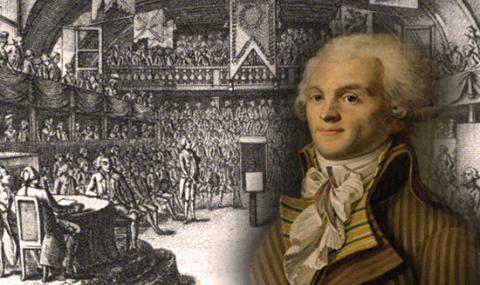

On July 28, 1794, Maximilien Robespierre was guillotined on the Place de la Revolution in Paris.
Just a day earlier, he had been arrested for his calls to execute 17,000 "enemies of the Revolution."
In 1789, Robespierre began a political struggle in connection with the elections for the Estates General. The vote was called by the king in an attempt to find a way out of bankruptcy.
Robespierre published two pamphlets in which he proved the illegitimacy of absolute monarchy as a form of government and rejected the entire system of the old regime. The Third Estate of Arras elected him a deputy to the States-General, with the deep conviction that he would consistently defend their interests. Indeed, he often took the floor on the most important political issues - on the nature of power, on the privileges of the nobility, on the rights of the people. His appearance on the rostrum was always preceded by careful preparation: both his appearance and his speech were impeccable.
Together with a few deputies such as Saint-Just, Couton, Le Bain, he formed the extreme left of the Assembly. Thanks to his perseverance and consistency, he established himself as the leader of this small group. The Arras jurist had a clear, uncompromising position on the great question of the prerogatives of royal power, which was discussed at length in the Assembly in connection with the preparation of the Constitution. For him, the sovereignty of the nation was the sovereignty of the people.
Robespierre was among the deputies who refused to recognize the king's right of veto. When considering the "Declaration of the Rights of Man and of the Citizen", he defends the principles of bourgeois democracy, opposes the division of citizens into "active" and "passive" according to property status, and advocates the worldwide expansion of political freedoms to introduce universal suffrage.
Two years after the beginning of the revolution, Robespierre is already a recognized leader of the revolutionary-democratic wing of the bourgeoisie.
In 1792, after the overthrow of the monarchy, the center of Robespierre's attention became the compromising policy of the Girondins, who sought to defeat the left-wing forces, which was dangerous for the future of the revolution. The irreconcilable revolutionary exposed their intention by inciting a revolutionary war against the European feudal-monarchical states. He warned that it would be treason to embark on the path of military collision with other countries before the revolution had consolidated. Together with Marat and other revolutionaries from the “Mountain”.
Robespierre fought against the Girondins on the issue of the king's fate and, although he had a negative attitude towards the social ideas of the “madmen” in 1793 he became close to them in the name of defeating the internal counter-revolution.
After the popular uprisings of May 31 and June 2, 1793, which put an end to the power of the Girondin bourgeoisie, the Jacobin dictatorship was established in France, and thus the hour came for Maximilien Robespierre to realize his political and social ideals. Standing at the head of the Committee of Public Safety and assuming the leadership of the country, he shines as a theorist, but also as the undisputed leader of the revolution.
However, Robespierre's petty-bourgeois ideology is the reason for him to lose the support of the masses, and this turns out to be fatal for the Jacobins and their leader. He turns out to be unable to understand that by eliminating the "madmen" he is depriving himself of the most massive support of the Jacobin government. In this situation, a conspiracy of the reactionary right and the extreme left in the Convention against Robespierre and his supporters occurs, which ends with his arrest on June 27, 1794.