


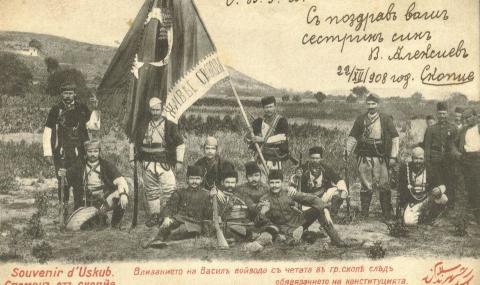

Macedonia occupies a key place not only in the history of Bulgaria, but also of the Ottoman Empire and modern Turkey.
In 1908, events began in Macedonia that would change the fate of the Balkan Peninsula.
On July 3, 1908, Major Ahmed Niyazi Bey and Enver Bey raised a rebellion among the soldiers of the Third Army, stationed in the Macedonian city of Resen. Military units commanded by Niyazi Bey and Eyup Sabri entered Bitola and captured the local military commander Osman Pasha.
A group of about 200 soldiers and civilians set out for the capital with demands for the restoration of the 1876 constitution. The uprising quickly spread among the military units throughout the European territory of the empire and the government in Constantinople failed to organize armed resistance.
On July 24, 1908, Abdul Hamid II capitulated and officially announced his agreement to satisfy the demands of the rebels.
This marked the beginning of the Young Turk Revolution.
The Young Turks is a general name used to designate several groups of dissidents and conspirators who emerged at the end of the 19th century, both in the territory of the empire and in emigration. In 1889, at the Higher Military Medical School in Constantinople, Abdullah Cevdet and his fellow students founded the Committee for Unity and Progress as an illegal political organization, which was quickly joined by students from other higher educational institutions in the capital. Subsequently, the Committee became the dominant force in the Young Turk movement. When the organization was exposed by the authorities, some of the leaders fled abroad and joined the Ottoman dissident emigration in Paris, Geneva and Cairo.
The Bulgarian government of Alexander Malinov took advantage of the instability that occurred in the Ottoman Empire immediately after the Young Turks came to power, and on September 22, 1908, in the church of “St. Forty Martyrs“ in Tarnovo with a special manifesto proclaimed the independence of Bulgaria, with Prince Ferdinand I accepting the title of Tsar of the Bulgarians.
Almost at the same time, Austria-Hungary announced that it was annexing Bosnia and Herzegovina, which had been under its occupation for 30 years according to the Treaty of Berlin.
A few years later, an assassination attempt in Sarajevo marked the beginning of World War I.
IMRO and the Young Turks
A central element of the Young Turk Revolution was the unity between the Young Turks and the activists of the IMRO. Due to the chaos created in the central leadership after the 1903 uprising and the death of Damian Gruev in 1906, the Internal Organization did not seem to have a clear position regarding the Young Turks and their activities, and a number of memoirs from this period speak of a lack of coordination, and in general, the transmission of information between the various revolutionary districts immediately before and after the announcement of the Hurriyet. Nevertheless, there was an exchange of letters between the Young Turks and the most influential Bitola Revolutionary District, thanks to which the visible tension caused by the unsettled relations between the two organizations was reduced.
The initial euphoria and the proclaimed new equality between the ethnic groups in the empire led the Bulgarian bands to end the armed struggle and descend from the mountains with the favor of the Ottoman authorities. The VMORO emerged from underground and its main wings split into two new political parties - the Union of Bulgarian Constitutional Clubs and the People's Federative Party (Bulgarian section). In 1908, four Bulgarian deputies were elected to the Turkish parliament: Todor Pavlov, Pancho Dorev, Dimitar Vlahov and Hristo Dalchev.
Some voivodes such as Alekso Stefanov and Todor Alexandrov did not fully trust the promises of the Young Turks.
Others such as the legendary Apostol Petkov – The Enijevardar Sun met their death in the fight against the Young Turks precisely after the renewal of revolutionary activity.
Yane Sandanski, on the other hand, benefited from the change of power in the Ottoman Empire.
Not long after, the nationalism of the Young Turks prevailed over the reformist ideals and they resumed repression with renewed vigor.
On April 13, 1909, the army units of the Istanbul garrison rebelled and demanded the return of Sharia (customary law), Islamic order, and the expulsion of the leaders of the Young Turks from the Ottoman Empire, recalls the website "Bulgarian History".
The Sultan immediately accepted their demands. The leaders of the Young Turks, led by the army corps in Thessaloniki and Edirne, as well as the created paramilitary formations, set off on a march towards Istanbul. Under the leadership of Yane Sandanski, Hristo Chernopeev and Todor Panitsa, 1,200 Chetniks from the Internal Macedonian-Edirne Revolutionary Organization (IMRO) participated in it. When they approached the city, units of the Ottoman Navy also joined the counter-revolutionaries, who blocked the capital by water. On April 26, they managed to put the capital completely under their control and the Sultan's counter-coup attempt was finally thwarted. The next day, the Ottoman Empire dawned with a new sultan - Mehmed V.