


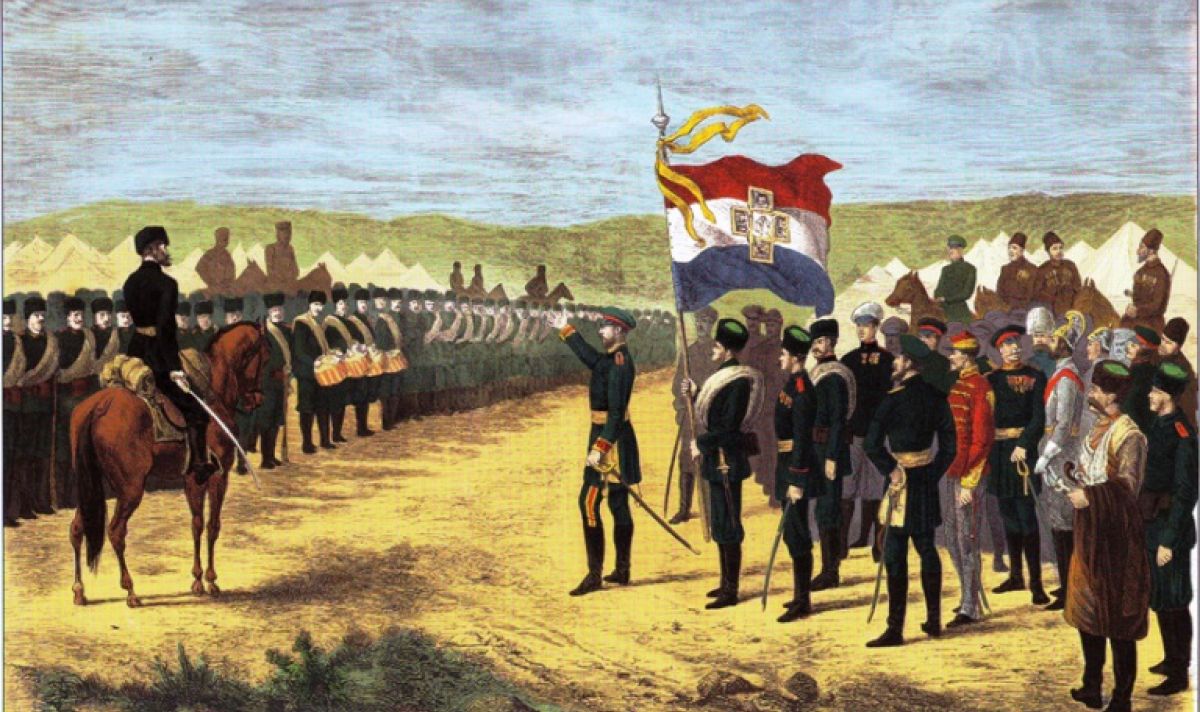

On May 18, 1877, the Bulgarian militia formed in Ploiesti received the Samara flag. It was sewn by the nuns of the Iversky Maiden Monastery (Samara) from heavy silk fabric of three colors - crimson, white and light blue. On both sides of it there was a black cross, trimmed with beautiful golden arabesques. In the middle of the cross on one side was depicted the Iversky Icon of the Mother of God, and on the other side - the holy brothers Cyril and Methodius and the respective inscriptions: “The city of Samara, to the Bulgarian people in 1876“ and “May God rise and waste away his enemies.“
On May 18, 1877, in Ploiesti, a delegation from Samara, headed by Efim Kozhevnikov, presented the Samara flag to the Bulgarian militia at a special ceremony, in which the flag was nailed to the handle with golden nails. The last nail was nailed by the old champion, the voivode, grandfather Tseko Petkov, who took off his cap and, looking up to the sky, exclaimed:
“May God grant that this holy flag may pass from end to end through the long-suffering Bulgarian land. May our mothers, wives and sisters wipe their sorrowful eyes with it, and after it may lasting peace and prosperity come.“
When the ceremony ends, a torrential rain falls, and a dazzling lightning flashes over the Carpathians. All this was interpreted as a sign of a good beginning and a pledge of the success of the liberation cause.
The Samara flag, while the military actions of the Bulgarian militia continue, flutters over the fighting militiamen and inspires them to show miracles of heroism.
It is known that the Samara flag is a symbol of our Liberation from Turkish slavery. But almost no one knows about the miracles that the Mother of God performs through the Samara flag. During the heavy battles for Stara Zagora in July 1877 The Mother of God appeared above the fighting militiamen with their last strength and with a sword in hand defended her flag. In battles in just one day, five standard-bearers of the Samara flag died. But the shrine was saved from capture and desecration. Thus, the Samara flag began the tradition of the Bulgarian battle flag not being captured.
A month later, the epic battles of Shipka began. The commanders ordered all Russian soldiers and Bulgarian militiamen to sing the hymn dedicated to the miraculous Kazan icon of the Holy Mother of God before the battle. The positions of Shipka were held, and the enemy was repelled. Captured Ottoman soldiers recounted: “We saw that you were few in number, but suddenly, out of nowhere, infantry, artillery and even cavalry appeared with you and we were forced to retreat!“
Years later, this incident was described by a Russian officer to the monks of the Russian monastery “St. Panteleimon“ on Mount Athos. He ended his story with the words: “The miraculous protection of the Holy Mother of God over our army was evident…It was precisely She who appeared to the enemy as a large number of warriors!“
However, let us note that the banner became famous during the Battle of Stara Zagora. The banner company came under frontal enemy fire. The banner bearers, Non-Commissioned Officer Anton Marcin, Non-Commissioned Officer Avksentiy Tsymbalyuk and volunteer S. Minkov, were killed. The feat of Lieutenant Colonel Pavel Kalitin, who with heroic efforts and the cost of his life managed to save the flag from Turkish captivity, remains famous in history. It was carried from the battlefield after a fierce hand-to-hand fight by the spontaneously formed Flag Group - Non-Commissioned Officer Toma Timofeev, volunteer Nikola Korchev, Pavel Malkiya, D. Minkov, Popov, Radev, Mitsov, Donev, Nikola Krastev, the Ossetian Nikolay Karaev-Dudar and others.
It was also carried in the Battle of Shipka and the Battle of Sheinovo.
After the war, the 3rd Volunteer Battalion was transformed into the 3rd Infantry Radomir Infantry Battalion and the Samara Flag was kept in its garrison in Radomir, from where its last standard-bearer was Nikola Korchev.
In 1881 The battalion received another flag and between 1881 and 1946 the Samara flag was kept in the Palace in Sofia (now the National Art Gallery).
In 1946 it was transferred to the National Military History Museum, where it is still kept in a chamber under special conditions.
On the occasion of the third anniversary of the bloody battles at Stara Zagora on July 19, 1880, a jubilee celebration was held. During the celebration, the flag of the Third Volunteer Battalion - Samara Flag - was awarded the first degree of the Order of Bravery for the first time. The Samara Flag is the only flag awarded the Order of Bravery, with its insignia embedded in the richly decorated handle.
In 1958 Two copies of the flag were made, one of which was sent to the Central Military Museum in Russia, and the other remained in Bulgaria. In 1978, the restoration department of the Military History Museum made another copy for the museum.
In 2004, the President of Bulgaria Georgi Parvanov donated a fourth copy of the flag to the Zograf Monastery. In 2006, the nuns of the Knyazhev Monastery “Protection of the Most Holy Theotokos“ donated a fifth exact copy of the flag to the Military History Museum, which occupies the place in the exhibition, and the third copy was donated to the Guard for Military Rituals.