


This report represents an in-depth expert analysis of the official response from the Ministry of Interior (MoI) with reg. No. 812104-12 of 06.01.2026, provided under the Access to Public Information Act (APIA). The document sheds light on the mechanisms through which hundreds of millions of leva collected from sanctions remain blocked in the state treasury, instead of saving human lives.
The data reveal a sustainable and upward trend in the fund's revenues. This trend is a direct consequence of the expansion of video surveillance systems and the automated issuance of electronic tickets.
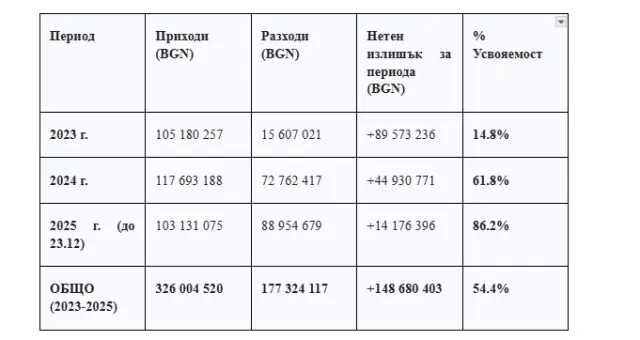
Source: Calculations based on Ministry of Interior Decision No. 812104-12/06.01.2026 1 and accumulation data.
The figures show that the Ministry of Interior generates an average of between 105 and 117 million leva per year from fines under this mechanism alone. This confirms the IPB's finding that "the system has been turned into an industry". It is noteworthy that even in conditions of economic fluctuations and political instability, the "production" of fines works flawlessly.
However, this high collection rate also reveals a worrying symptom: the punishment does not deter. If sanctions worked preventively, the number of violations and, accordingly, the revenue from fines should decrease over time, as drivers correct their behavior. The stable growth in revenue (from 105 million to 117 million leva) indicates that violations are reproduced, and fines are perceived more as a "toll fee" or an inevitable tax, than as a corrective to behavior.
In 2023, a year of extremely high road mortality, the Ministry of Interior absorbed only 14.8% of the funds received. The remaining 85% (nearly 90 million leva) have remained blocked. This is a managerial absurdity. In the private sector, a similar level of implementation of an investment program would lead to an immediate change of leadership. In the public sector, this is justified by bureaucratic procedures and a lack of project readiness.
The growth in spending in 2024 (up to 72 million leva) and 2025 (up to 89 million leva) seems positive at first glance, but the structural analysis of these shows that they are primarily aimed at departmental needs, not at public benefit. Even with the increased spending, the fund continues to generate a surplus, which accumulates on the huge transitional balance. The most shocking indicator of inefficiency is the size of the accumulated transitional balance.
01.01.2023: 333,448,904 BGN.
01.01.2024: 423,022,140 BGN.
01.01.2025: 467,952,911 BGN.
23.12.2025: 482,129,307 BGN.
By the end of 2025, the FBD has nearly half a billion BGN of free resources. The fact that these funds remain unused, while the number of deaths is over 500 per year, is direct evidence of the IPB's thesis of "zero effect". The state has seized this resource from citizens under the pretext of safety, but has not returned it in the form of a service. In its response, the Ministry of Interior provides a detailed legal explanation as to why the fund's accounts "have no funds available" at the time of the inquiry. This explanation reveals the fundamental structural problem of public finance management in Bulgaria.
The mechanism is as follows:
The citizen pays a fine (for example, 100 leva for speeding).
The money is transferred to a transit account of the Ministry of Interior.
At the end of the day (or period), the BNB automatically "resets" this account and transfers the money to the central budget reserve (the Single Account), managed by the Ministry of Finance (MoF).
Accountingly, the MoF reports this money as "fund revenue", but physically the money is already mixed with revenues from VAT, excise duties and other taxes.
The budget buffer and the lack of autonomy turn the FBD into a virtual structure. Two interests clash:
The interest of the MoF/Society: To spend money on safety.
The interest of the MoF: To maintain a budget surplus (or reduce the deficit) on a cash basis.
Since the transitional balance of 482 million leva is already part of the fiscal reserve, any of its spending increases the cash deficit for the current year. Therefore, the MoF has a strong incentive to limit the fund's spending, using it as a buffer. Thus, the money for "life" is used for macroeconomic stabilization. This explains why, with hundreds of millions of available resources, crumbs are allocated for real activities. This confirms the concerns of the IPB that the fund is being used to "fill the budget".
The audit launched in early 2025 by the National Audit Office is a critical moment for the future of the fund. The audit was triggered by the IPB's Opinions on the "threatening dimensions of the war on the roads" and "lack of transparency".
Based on public data, it can be predicted that the audit will find:
Low cost efficiency: Huge investments in equipment have not led to a corresponding decrease in road accidents.
Slow absorption: The accumulation of a transitional balance is evidence of poor planning and managerial weakness.
Lack of goal setting: Spending is made "piecemeal", without a long-term strategy for priority elimination of black spots.
Use of funds for purposes other than intended: Confirmation of concerns about the use of cars for purposes other than road safety.
The Court of Auditors will probably make recommendations for changes to the regulatory framework to ensure a higher level of targeting of funds towards infrastructure measures, which coincides with the demands of IPB.
Based on the analysis of the data provided by the Ministry of Interior and in the context of the long-term expertise of the IPB, the following categorical conclusions and recommendations are required:
7.1. Conclusions
Fiscal cynicism: The state has accumulated 482 million leva from fines for drivers, which it uses as a hidden budget buffer, while the infrastructure is collapsing and taking victims.
Mistaken priorities: The 20:1 expenditure ratio in favor of equipment over infrastructure shows that the Ministry of Interior prioritizes its own comfort and control functions over the real safety of citizens.
Institutional trap: The mechanism of Art. 154 of the ZPF effectively blocks the funds and deprives the fund of operational autonomy, turning it into a hollow structure.
Failure of repression: The increasing revenues from fines with an unchanged number of victims prove that the strategy of "more fines" is exhausted and ineffective without a change in the environment.
Recommendations for action
The Road Safety Institute insists on immediate and radical measures:
Unblocking 482 million leva: Urgent adoption of a Decree of the Council of Ministers for a targeted investment program "Safe Infrastructure", financed by the transitional balance of the fund. The funds should be transferred to the RIA and municipalities for specific sites (black dots).
Legal quota for infrastructure: Amendment to the Road Tax Act and the Regulation on Fund Management, which would imperatively oblige a minimum of 50% of the fund's annual revenues to be invested in passive road safety (infrastructure), and not in equipment and salaries.
Transparency of the "Single Account": Creation of a public register in real time, which would show the accumulation of funds and their spending, in order to end the practice of budget fog.
Moratorium on the purchase of cars: Suspension of orders for new cars with funds from the fund until a full functional analysis of the existing fleet and its efficiency is carried out.
Civil control: Inclusion of representatives of the non-governmental sector (including IPB) in the Management Board of the fund with the right to an advisory vote and access to documentation.
It is time for the voices of experts and civil society to be heard. Continuing the current policy is not just an administrative error - it is measured in lost human lives. The response of the Ministry of Interior confirms the diagnosis; now it is the turn of society to impose treatment.
The report was prepared by the expert team of the Road Safety Institute based on official information as of January 2026.