


On the island of “St. St. Kirik and Julita“ near Sozopol, a modern port for passenger ships and a yacht marina is planned to be built. This became clear at the end of January from a statement by the Deputy Prime Minister and Minister of Transport and Communications, who resigned. According to him, by a decision of the Council of Ministers, part of the island is being transferred for management from the Ministry of Culture to the state enterprise “Port Infrastructure“. The goal is to develop the tourist infrastructure and relieve the load on the fishing port in Sozopol.
“Port Infrastructure“ is planned to modernize the quay wall and the entire infrastructure, to build a terminal for servicing passengers and tourist ships, a modern yacht marina marina, as well as a public access area with the possibility of mooring attraction vessels. At the same time, the Ministry of Culture will retain access to the island and the opportunity to develop and preserve the archaeological area. The state enterprise will also support the activities of the Center for Underwater Archaeology in Sozopol, which is about to become an institute under the auspices of UNESCO.
In the beginning
So far, everything seems logical on paper. In practice, however, serious questions arise. In the process, without public debate, a significant land plot turns out to be divided into two - without a Detailed Development Plan (DDP) in force, but with a draft for new identifiers. It is unclear whether the properties have a secured person, what the access is, what the development regimes are and whether the newly formed properties comply with the Spatial Planning Act. However, the new properties already exist in the cadastre.
The official interpretation is conditioned as “functional division“ and “compliance with cultural heritage“. At the same time, the Institute for Immovable Cultural Heritage itself admits that there are no motives, graphic materials and clarity as to whether the division complies with the protection regimes. However, it proposes that the project be coordinated. The deadline is also indicative - the application was submitted on January 5, 2026, and the opinion from the Institute for Immovable Cultural Heritage was issued on January 6, although the law allows for a period of up to two months. Immediately afterwards, an authorized deputy minister of culture signed the final opinion under the Cultural Heritage Act, which practically legalizes the disputed act.
However, the key question remains: how is a land plot divided without a valid or amended Detailed Development Plan (DDP)? The answer is - according to Grozdan Karadjov, that such a plan is to be prepared subsequently. And this is a practice that calls into question the compliance of the of the state.
This was a reminder. You can read our first article HERE. There is simply development. And what.
The Saga
With a letter from the Center for Underwater Archaeology dated March 4, 2026, the topic takes on a very interesting character. The editorial staff of FAKTI has the letter, but we will tell it chronologically.
By decision of the COUNCIL OF MINISTERS No. 60/21.01.2026, the Council of Ministers revokes “due to a lost need” from the Ministry of Culture the right to manage a property on the island of “St. St. Kirik and Julita” and transfers it free of charge for management of the State Enterprise "Port Infrastructure" (SPI) with the aim of creating a port terminal. This was implemented by DIVISION of a property (PI 67800.501.577), which covers the territory intended for a cultural center and managed until recently by the Ministry of Culture, into two properties: PI 67800.501.621 with an area of 42,713 sq.m and PI 67800.501.622 with an area of 35,774 sq.m. It was the latter that was transferred to SPI.
(b.r. – the two properties are divided without a Detailed Development Plan having entered into force, which will be discussed, and it also turns out that the property PI 67800.501.621 (in blue) remains without an entrance and exit)
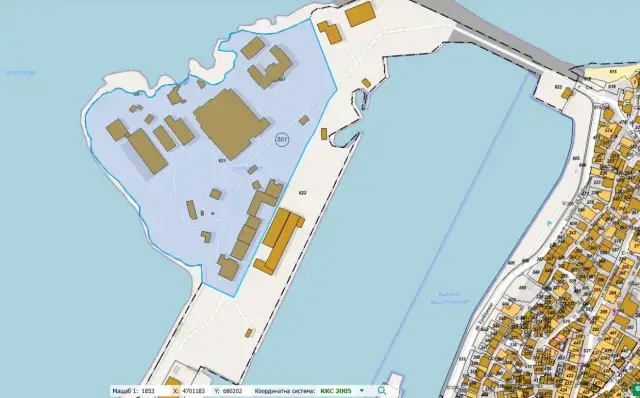
The island of “St. St. Kirik and Julita” near Sozopol has been declared a group archaeological, architectural and historical immovable cultural property with the category of “national significance” and for years has been planned as a place for culture, science, education and a museum center. The cultural center project also benefits from the support of UNESCO, including as a location for the headquarters of the Black Sea Institute for Underwater Heritage under the auspices of the Organization.
This decision caused a stir among experts, who also united in an Initiative Committee, the purpose of which is to acquaint the public with the objective facts about the development of the island. A petition prepared by the Initiative Committee points out a number of inconsistencies in the procedure for the decision of the Council of Ministers and the transfer of ownership, such as the lack of clear criteria by which the scope of the newly formed two properties was determined, as well as obvious gaps in the current legislation.
It should be noted that in addition to being a national problem, the decision to divide the island of “St. St. Kirik and Julita” threatens to become an international issue. After receiving a signal about the decision of the previous government, UNESCO requested an urgent meeting with interested Bulgarian representatives, during which it expressed its categorical concern about such a decision. According to the representatives of the Organization, such a decision contradicts the overall concept with which the Bulgarian state has applied to host a category 2 "Underwater Heritage Institute" for the Black Sea region, the agreement between the government of the Republic of Bulgaria and UNESCO, as well as the official letters exchanged between the ministers of culture of the Republic of Bulgaria and UNESCO. UNESCO was reminded that their agreement was expressed to hold competitions for conceptual ideas and/or restoration of the property, if necessary, in order to attract proven international experts to work together with the Bulgarian teams.
JUSTIFICATION REGARDING LEGAL AND PROCEDURAL INCONFORMITIES
At the end of 2022, in connection with the requirements of the Cultural Heritage Law, Order No. RD-09-1178/25.10.2022 of the Deputy Minister of Culture was issued, published in the Official Gazette, which granted status and updated the territorial protection regimes (borders and protection zone) and prescriptions for the protection of the site “island “St. St. Kirik and Yulita", town of Sozopol, Sozopol municipality, Burgas region, with a classification of group archaeological, architectural and historical immovable cultural value, category „national significance". According to the regulations for the protection of the territory: „It is defined as a territory for geophysical research, conservation, restoration, exhibition and socialization of architectural and archaeological immovable cultural values. The type of ownership of the part of the property included in the territorial scope of GAAINCC is preserved."...., „New construction is allowed, except in the case of explicitly proven necessity, as well as construction and installation works (repair, reconstruction, etc.) on part of the remaining existing buildings in the property, which, after the preparation of the relevant project documentation, are required to function in accordance with the purpose of the territory."..., „Rehabilitation and maintenance of the constructed and existing engineering port infrastructure is allowed. The use of this infrastructure is permissible only for the needs of: DG “Border Police”, ensuring tourist access. The terms and conditions for the exploitation of this infrastructure are regulated on the basis of an agreement between the MIC and a competent structure, in compliance with the regulations for the protection of the territory and the water area of the site.”
According to the above-quoted order: “In connection with the extremely high cultural and historical value of the territory and the need to ensure the possibility of conducting archaeological research and adequate exposure in a natural environment of archaeological values; conservation, restoration and socialization of architectural and construction immovable cultural values and implementation of plans for the future functioning of the territory, after the completion of the procedure for updating the status and registration of the GAAINCC island “St. St. Kirik and Yulita", it is necessary to initiate the preparation and proceeding of an amendment to the current PUP-PRZ for the determined territorial scope of the group immovable cultural value, in accordance with the prepared conservation prescriptions.
In connection with the requirement regulated in Art. 2, para. 1, item 2 of the Ordinance on the scope, structure, content and methodology for the preparation of plans for the protection and management of single or group immovable cultural values (D.V., issue 19/08.03.2011; as amended and supplemented), it is necessary, after the completion of the procedure for granting status and registration of GALINCKS island “St. St. Kirik and Yulita", town of Sozopol, to initiate the preparation and proceeding of a POU (Preservation and Management Plan) in accordance with the procedure of the cited Ordinance."
According to Art. 84, para. 9 of the ZKN: “For investment projects and requests for interventions in protected areas for the protection of cultural heritage under Art. 83, coordination or refusal to coordinate is carried out on the basis of verification of compliance with the requirements of the ordinance under Art. 171, a coordinated development plan and a design visa or placement scheme and with the protection regimes for the relevant territory."
According to Art. 15 of the ZTA:
para. 3: “The boundaries of regulated land properties may be changed with a regulation plan.....", and not with a draft project for the division of PI67800.501.577 (note - this is the identifier of the plot that is divided into two) directly at the Agency for Geodesy, Cartography and Cadastre.
para. 6: The act of approval of the regulation plan, which changes the boundaries between regulated land properties in accordance with the procedure of para. 3, shall enter into force upon its issuance and shall be communicated to the applicants.
para. 8: Construction in regulated land properties, the boundaries of which are changed by the regulation plan in accordance with the procedure of para. 3, shall not be permitted when, as a result of the amendment to the regulation plan, the development plan for the relevant regulated land properties is in contradiction with the current development rules and regulations.
para. 11: Copies of the amendments to the detailed development plans under para. 3 that have entered into force shall be sent ex officio by the municipality to the Agency for Geodesy, Cartography and Cadastre after submission of a final contract under para. 3, 4 or 5.
According to art. 14 of the ZUT:
para. 1: The detailed development plans regulate streets, as well as neighborhoods and land properties for development and for other needs without development.
par. 4: Regulated land properties have a mandatory face (exit) to a street, to a road or, exceptionally, to an alley in a park.
As can be seen from the cadastral map, after the separation of the new PI 67800.501.621 and PI 67800.501.622, PI 67800.501.621 remains without an exit to a street or road and without any transport access either by land or water.
Meanwhile, with protocol decision 39.25 of September 25, 2025, the Council of Ministers of the Republic of Bulgaria approved the package of documents for the UNESCO Executive Board related to the declaration of the Center for Underwater Archaeology as a category 2 “Institute for Underwater Heritage” for the Black Sea and Lower Danube region. Among the documents are the report of the UNESCO evaluation mission, which explicitly states in its recommendations the obligation of the Bulgarian state to transform the island of “St. St. Kirik and Julita” into a cultural center, within which the headquarters of the future institute under the auspices of the Organization will also be located. The Bulgarian state continues with the procedure for signing and ratifying the agreement with UNESCO, of which the aforementioned report is an integral part, while simultaneously adopting a subsequent decision that is in complete contradiction with the one already adopted in October 2025.
On February 27, 2026, the National Assembly unanimously adopted the Law on Ratification of the Agreement between the Republic of Bulgaria and UNESCO on the Declaration of the Center for Underwater Archaeology as a Category 2 “Institute for Underwater Heritage" for the Black Sea and Lower Danube region, which implies the subsequent repeal and/or amendment of Bulgarian regulations that contradict this agreement.
The creation of a port terminal to serve the museum and cultural center is appropriate and necessary, but the division of the property and the assignment of part of it to the DPPI must follow the preparation of a task, concept and specialized detailed development plan for the museum and cultural center. This process should be carried out in joint consultations with all interested parties and in coordination with UNESCO.
Thus, it is requested that Decision No. 60 of 21.01.2026 be CANCELLED DUE TO THE CLEAR CONTROVERSY both with the already existing national legal framework and with international law, in particular the agreement between Bulgaria and UNESCO.
It should be noted that the decision to divide the property granted to the Ministry of Culture into two and to grant one newly formed PI to the DPPI was taken without public discussion, was not considered by an expert or interdepartmental working group, and was not discussed by the Specialized Expert Council for Immovable Cultural Heritage (SESONKC) of the Minister of Culture, despite its exceptional importance.
An existing Concept for the Preservation and Sustainable Development of the Island, created by an expert group led by Prof. Arch. Todor Krastev on behalf of the Ministry of Culture, was also not taken into account, according to which the property provided to the DPPI includes areas and buildings that constitute an important integral part of the project: a reception area, an open-air museum "The Anchors", an area for the archaeological park, an aquarium, a parking lot, a berth for a research vessel of the Center for Underwater Archaeology, etc.
According to the opinion of the National Institute of Marine and Coastal Research (dated 06.01.2026), with which the DPPI project for the separation of two properties was coordinated, “The determination of the two newly formed properties with a permanent use type “Another type of land property without a specific economic purpose” DOES NOT COMPLY WITH THE REGIME FOR PROTECTION OF GROUP VALUE.
The opinion issued by the Deputy Minister of Culture CONTRADICTS SUBSTANTIVE LEGAL NORMS, namely Art. 84, para. 9 of the ZKN. For the GALINCK island “St. St. Kirik and Julita" there are certain regimes for protection, in violation of which the above-cited individual administrative act was issued by the Deputy Minister of Culture.
Obviously with the issued coordinating opinions under Art. 84, para. 7 of the Cultural Heritage Act of the Director of the NINKN and under Art. 84, para. 1 and para. 2 of the Cultural Heritage Act of the relevant Deputy Minister in the Ministry of Culture, the amendment of the cadastral map and cadastral registers and the decision of the Council of Ministers ARE VIOLATED The Law on Spatial Planning, the Law on Cultural Heritage and the Protection Regimes of the GALINCKC Island “St. St. Kirik and Julita", the Law on the Cadastre and the Property Register.
What does it mean here to divide a property in two, to have no Detailed Development Plan, to have a property without an entrance and exit, but to be included in the cadastre. What is the problem! Let us give, while the ministers are ours. Otherwise, what's the big deal – the important thing is to be alive and well!

Island "St. St. Kirik and Julita and what do some laws mean here...
The Institute for Immovable Cultural Heritage itself admits that there is a lack of motives, graphic materials and clarity as to whether the division complies with the protection regimes
Apr 1, 2026 08:53 386
