


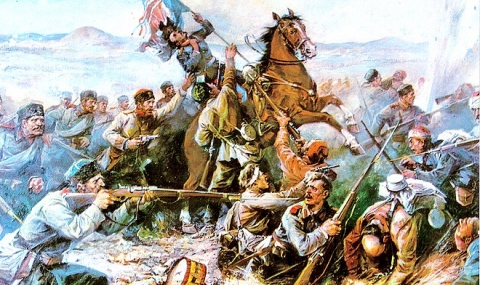

July 31, 1877 - The Russo-Turkish War was in full swing.
On this date near Stara Zagora, the first major clash between the two warring armies took place, the outcome of which largely predetermined the subsequent development of the military operations. What's more - on that sultry July day, about 3,500 Bulgarians in the Bulgarian Volunteers, with the legendary Russian General Nikolai Stoletov as commander, entered the battle for the freedom of their homeland for the first time. Ready, as they themselves claim, to sacrifice themselves to the last drop of blood, writes the Bulgarian History website.
However, let's start with a prehistory. According to the plan of the Russian Minister of War Dmitry Milyutin, who signed the order for the creation of the Bulgarian Volunteers and prepared the overall strategy for the preparation and conduct of military operations, after the crossing of the Danube River on June 27, 1877, the liberation troops were divided into 3 detachments: Western Detachment - 35,000 soldiers, Eastern Detachment - 80,000 soldiers and Forward Detachment - only 12,000 fighters (commander General Yosif Gurko), which included the composition of the Bulgarian Volunteers.
The Forward Detachment began the war convincingly - it managed to capture important cities on its way to the Balkans. On July 7, parts of the Forward Detachment entered Veliko Tarnovo, and on July 16, they crossed the Stara Planina Mountains through the Hainboaz Pass. On July 19, control was established over the Shipka Pass, which was important for the connections between Northern and Southern Bulgaria. In this way, the path for an offensive to the wide fields of Thrace was opened. The Ottoman command, shocked by the actions of the liberation army, ordered the transfer from Albania to Southern Bulgaria of the huge army of Suleiman Pasha - a French graduate and professor of literature at the Sorbonne, a brilliant poet who would later commit a real war crime, subjecting the Bulgarian population in Southern Bulgaria to a real genocide.
Here we should mention that the “avant-garde detachments“ of Suleiman's army were composed of Circassians and Albanian bashibozuks, who after their arrival on Bulgarian soil were also accompanied by part of the local Muslim population. According to various sources, the total number of Ottoman forces that began the offensive towards Stara Zagora on the eve of the battle was between 20,000 and 27,000 soldiers from the regular army and between 1,200 and 2,000 bashibozuks. The movement of this military unit to the north was accompanied by violence against the Bulgarian population, and this was not accidental. As Suleiman himself would later confirm in his testimony during the trial conducted against him by the Turkish court, he ordered all Bulgarian settlements south of the Balkan Mountains to be wiped off the face of the earth. The first reports of the massacres of Bulgarians in the villages south of Stara Zagora began to arrive in mid-July:
„On the 12th, men, women and children, naked and barefoot, began to arrive from the villages, among whom there were carloads of wounded. They said that Bashibazouks and Circassians attacked the villages, killing whoever they could find; they robbed, dishonored and set the villages on fire. And the citizens themselves from the heights of the city began to see the smoke and flames from the burning villages. Sorrowful and unpleasant rumors began to circulate around the city that day….”.
It is important to note that the day before that – July 11 (July 23, new style), the commanders of the Front Unit and the Bulgarian Volunteers (1st, 2nd, 3rd and 5th companies) – Gen. Gurko and Gen. Stoletov were welcomed in the liberated Stara Zagora. On July 24, Petko R. Slaveykov welcomed the liberating troops to the church of "St. Dimitar" and in conditions of exceptional solemnity, in front of the gathered thousands of citizens and the entire clergy, a prayer service was served. Slaveykov delivered a speech to General Gurko in "one Slavic-Russian language" that was so touching that it filled everyone gathered in the temple of God with emotion. This was witnessed by the Stara Zagora Renaissance activist and teacher Atanas Iliev. A Temporary Management Commission was established with P.R. Slaveykov as chairman – organizer of the first civil government in Stara Zagora.
Meanwhile, Suleiman's army continued to advance towards the city, and three days before the battle it was blocked by the endless columns of refugees seeking refuge in Stara Zagora:
“On the 16th, the city began to fill even more with villagers. The rumor about the terrible massacre in the village of Güneliyska Mahala spread throughout the city in the morning…“.
On the eve of the battle, 4 volunteer battalions, 4 mountain guns, 3 cavalry regiments, 2 Cossack hundreds and 8 horse guns were stationed in the city - a total of about 4,500 people, occupying a defensive line 4 km long in the form of an arc about 1.5 km south of Stara Zagora.
The army of Suleiman Pasha — 41 camps, with numerous artillery, on its march from Tarnovo – Seimen north, towards the Balkans, spent the night about seven kilometers south of the city. On the morning of July 31, it continued its journey in three columns. The first attack on the positions of the militia began with cannon thunder and rifle shots at around 7 o'clock. The militia responded with several volleys. More and more Ottoman camps arrive along the road from Simenovgrad.
Around 10 o'clock, General Stoletov sends a message to Colonel de Preradovich, in which he tells him that he is entrusting him with the defense of the city, sending him reinforcements of 2 guns and the Kazan Dragoon Regiment. By this time, all the militia companies are already in position south of the city.
By noon, when the situation is almost untenable, all the reserves have entered the battle. Help can no longer be counted on. In this situation, the rear of the defenders is provided by numerous citizens, who very soon transfer to the battle line itself, getting hold of the rifles of the killed and wounded. The heroism of these people is so great that it is in no way different from that of the volunteers.
As time progresses, the battle heats up more and more, and while the volunteer battalions melt like spring snow, new and new Turkish forces arrive from the south. However, not a single volunteer thinks of retreating.
One of the most critical moments occurs when the Ottomans manage to wedge themselves between the 3rd and 5th battalions. Lieutenant Colonel Kalitin, commander of the 3rd battalion, manages to lead the soldiers. The enemy does not expect such an offensive, and the situation is temporarily saved. At the same time, the commander of the 3rd company, Staff Captain Popov, although wounded, leads his unit, which offers significant resistance. The battle has entered a turning point – there are reports that a few people managed to put entire Ottoman companies to flight.
At 1:00 p.m., after noon, Suleiman Pasha threw all his available forces against the defensive positions, which, seeing the threat of encirclement and having achieved their goal of holding back the huge army, began to retreat. The moment was extremely dramatic and the retreat should not have been delayed, so that the volunteers had time to regroup and take up positions on the Shipka Pass, unsurpassed by Suleiman Pasha's units.
The enemy correctly realized that the moment was suitable for a more serious offensive and attacked - the most brutal Ottoman blow was taken by the heroic Third Volunteer Battalion with its legendary commander, Lieutenant Colonel Pavel Kalitin. It, together with the 1st Volunteer Battalion, was to cover the retreat of the remaining units of the Stara Zagora detachment and enable the city's population and the tens of thousands of refugees from Thrace to escape to the north.
Upon entering Stara Zagora, Suleiman Pasha's soldiers massacred 14,500 Bulgarians from the city and the villages south of the city, and another 10,000, mostly young boys, girls and women, were kidnapped and sold in the slave markets of Turkey.
The city was burned to the ground and depopulated. The few remaining survivors escaped by fleeing to Northern Bulgaria, where they stayed until the spring of 1878. Many of them never returned to Stara Zagora. Even many contemporaries of that time believed that there would never be a city in this place again. In the battles for the defense of Stara Zagora, the Samara Banner and the Bulgarian Volunteers received their baptism of fire. After the disbandment of the Front Detachment, Gen. Gurko issued a farewell order, which said:
„…This was the first battle in which you entered into battle with the enemy, and in it you immediately showed yourself to be such heroes that the entire Russian army can be proud of and can say that it was not mistaken in sending its best officers to your ranks. You are the nucleus of the future Bulgarian army. Years will pass, and this future Bulgarian army will say: „We are descendants of the glorious defenders of Stara Zagora.”
After the heroic Battle of Stara Zagora of the Bulgarian Volunteers and the soldiers of Gen. Gurko with an opponent ten times superior to them, the liberation troops retreated to the peak of St. Nicholas in the Shipka pass, where they took up defensive positions.
This battle is especially epic due to the fact that in just one day, five standard-bearers and the commander of the third company, Lieutenant Kalitin, fell under the Samara flag. The flag was saved in hand-to-hand combat by the volunteer Nikola Karchev.