


Analysis of the remuneration of the management and control bodies of public enterprises based on the APPK report for 2024.
The scandal surrounding the remuneration in the National Palace of Culture has once again raised an old question: how much do state-owned enterprises pay their management and what does society receive in return for these expenses? Data from the Annual Summary Report of the Agency for Public Enterprises and Control (APPK) for 2024 provide an opportunity for such a comparison.
The state sector includes 261 public enterprises with over 120,000 employees, 21.6 billion leva in revenues and a net profit of about 1.3 billion leva. The most detailed information is published for the 56 enterprises categorized as large under the Accounting Act. They manage a significant part of state assets and form the main share of revenues in the public sector.
How are remunerations calculated and determined
Before proceeding to a comparison of specific amounts, it is important to understand the order in which remunerations are determined and reported in public enterprises.
Normative framework
Law on Public Enterprises (LPE) — the main normative act governing management;
Regulations for the implementation of the LPE — detail the order for determining remunerations;
National Code of Corporate Governance — recommended standards;
OECD Guidelines for Corporate Governance of State-Owned Enterprises.
Who determines the amount: The body exercising the rights of the state (the relevant ministry) determines the remunerations of members of the boards of directors or the management and supervisory boards. In a single-tier system (MB) — the ministry determines the remuneration of all members, including the executive director.
Fixed and variable component: According to the practice of the APPK, the remuneration of members of the management bodies consists of two parts: a fixed monthly amount (base salary) and a variable component tied to the implementation of the business program. The bonus scheme is activated only upon achieving certain financial and non-financial indicators.
What does the reported amount include: In Appendix 1 of the APPK report, the total gross remuneration paid for the entire body for the year is published — it includes salaries, bonuses, social security contributions at the expense of the employer and all other payments to members of the MB/MB/SC. That is, the indicated amounts are not the individual income of an individual member, but the sum for the entire board.
How to calculate individual remuneration: For a rough estimate — divide the total amount by the number of members. At Kozloduy NPP (5 members, 593 thousand BGN) the average per member is about 118,600 BGN per year, or about 9,900 BGN gross per month. At Bulgartransgaz (7 members, ~1,200,000 BGN) the average is about 171,000 BGN per year, or about 14,300 BGN per month.
Transparency and accessibility: Only the 56 enterprises categorized as large are obliged to provide these detailed data to the APPK. The remaining over 200 public enterprises are included in the summary report without an individual breakdown of remuneration. Data on the individual amounts per individual member are available in the notes to the annual financial statements of each company in the Commercial Register.
Important clarification: the amounts indicated in the tables below are TOTAL for the entire management body for year, not per individual member. For individual data, see the Activity Report of the respective company.
Who gets how much — top companies
The inspection shows that large remunerations are concentrated mainly in the energy and infrastructure sectors.
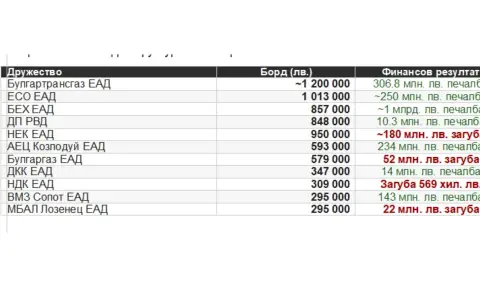
Note: The data is for 2023 from Appendix 1 of the APPK report. For Kozloduy NPP, the data for 2024 is from the published consolidated financial statement.
Against this background, the remuneration at NDK does not stand out as exceptionally high. The five-member Board of Directors received a total of 309 thousand BGN — significantly below the levels in large energy and infrastructure companies. The company reports revenue growth to over 17 million BGN and reduces the loss from 1.38 million BGN (2023) to 569 thousand BGN (2024).
When results justify the remuneration
The strongest arguments in favor of high remuneration come from companies with large profits.
BEH reports nearly 1 billion leva profit at 857 thousand leva for the board — less than one tenth of a percent of the financial result. Kozloduy NPP realizes 234 million leva profit at 593 thousand leva and even reports a decrease in the amount compared to 2023. VMZ Sopot earns nearly 143 million leva, and the board receives 295 thousand leva. In these cases, there is a visible and substantiated connection between the result and the payment.
Bulgartransgaz and ESO have the highest absolute amounts, but also some of the best financial results in the portfolio. Bulgartransgaz reports BGN 306.8 million in profit and equity of BGN 5.84 billion - managing such an asset requires appropriate competence.
Paradoxes of loss-making companies
More difficult to explain are cases in which companies end the year with losses, but continue to pay significant amounts to their management.
- Bulgargaz: BGN 579 thousand for the board with a BGN 52 million loss. The company ends the year with a negative equity of 190 million leva.
- MBAL Lozenets: around 295 thousand leva for the management with a 22 million leva loss.
- NEK EAD: around 950 thousand leva for the management bodies with a significant financial loss.
- BDZ Freight Transport: receives an unsatisfactory assessment for the implementation of the business program and continues to report financial difficulties.
- Shumensko and Smolyansko ViK: end with a negative equity (respectively -32.5 million leva and -14.7 million leva), despite the remuneration paid to the management.
These cases raise the question of whether the remuneration system is sufficiently tied to real results and whether financial performance should have greater weight in determining the remuneration.
On average, how much does a board member earn?
Calculations based on published data show that a member of the Board of Directors/Management in a large state-owned enterprise earns an average of between 60,000 and 180,000 BGN per year (5,000 — 15,000 BGN gross per month). This puts state-owned companies in a range similar to management positions in medium and large private companies in Bulgaria.
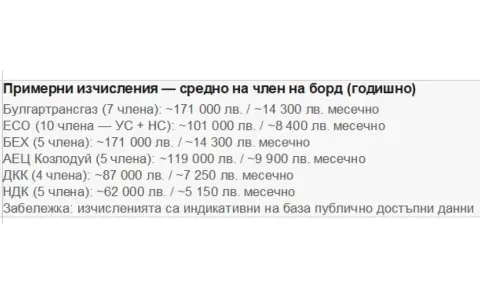
Note: the calculations are indicative based on publicly available data
In a number of European countries, the remuneration of the management of public companies is even higher. The difference is that the bonus schemes there are usually directly tied to financial results, investment programs and the quality of services — not just to the fact of holding the position.
What the experts say
Economists from the Institute for Market Economics have been pushing for a clear and measurable system for assessing effectiveness for years.
The problem is not the amount of remuneration, but the lack of a clear connection between results and remuneration. — Institute for Market Economics, position on the management of public enterprises
Transparency Without Borders emphasizes accountability: public control is possible only when information is easily accessible and comparable. Trade unions are drawing attention to the gap between board pay and employee income — especially in companies with financial difficulties.
Limitations of public data
The published detailed data covers only 56 of the 261 public enterprises. The remaining 200+ companies are included in the summary report without a breakdown by management remuneration. Four companies changed their category from large to medium for 2024 (Montazhi EAD, Kinteks EAD, SBR-NK EAD and UMBAL Burgas AD), while 10 new companies entered the category for the first time.
For the full picture by individual companies — The reports are available in the APPK electronic system at reports.appk.government.bg and in the Commercial Register for each company.
Conclusion
The debate that began around the National Palace of Culture has shown how sensitive the topic remains. The data reveals a much broader picture: the highest salaries are in energy and infrastructure - precisely where the most profitable companies are located. However, alongside them there are companies reporting significant losses or even negative capital, while continuing to pay hundreds of thousands of leva to their management.
The issue is not so much about the amount of salaries, but about the relationship between pay, achieved results and the public interest. It is this relationship that remains the most important criterion for assessing governance in the public sector.
Sources: Annual Summary Report on State Public Enterprises for 2024 (APPK) and Annual Consolidated Financial Statement of Kozloduy NPP EAD for 2024. The data on the remuneration of the remaining companies are for 2023 from media analyses of Appendix 1 of the APPK report.