


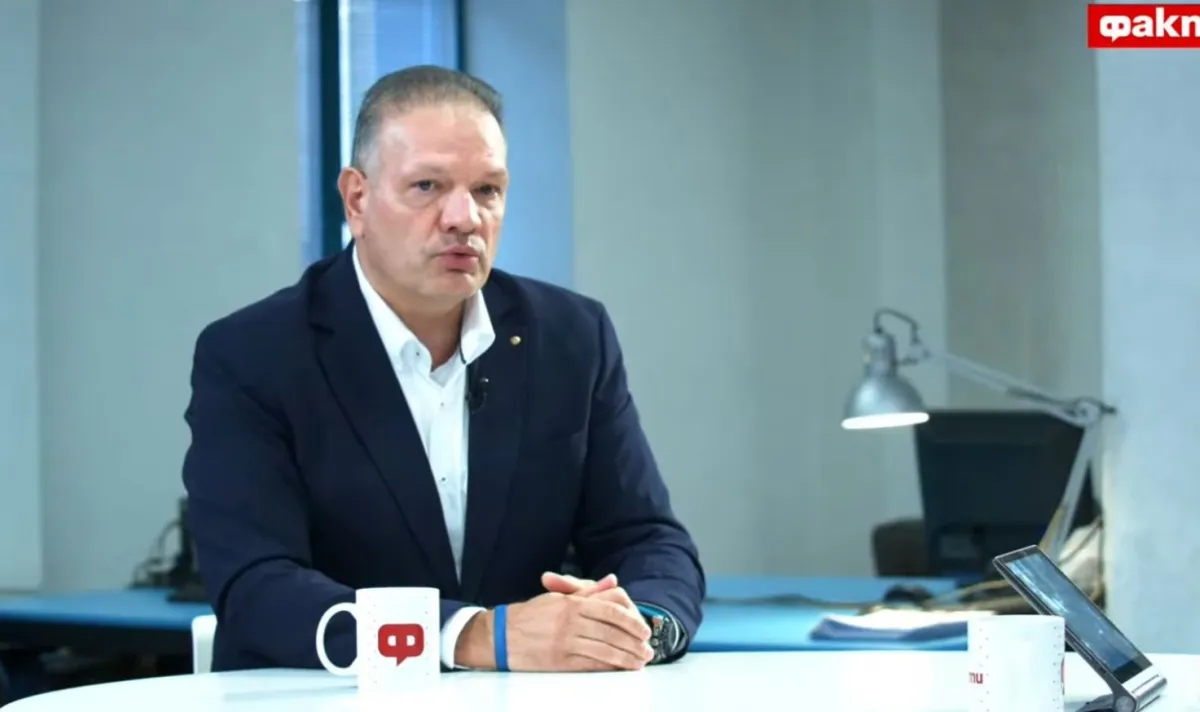

The election of a new prosecutor general, the composition of the Supreme Judicial Council and the risk of new political agreements are among the key topics in the conversation about the future of the judiciary. Is the fair election of members of the Supreme Judicial Council of crucial importance for restoring trust in justice. Here is what else lawyer Petar Slavov said to Lili Marinkova in the studio “FACTI“ and the show “Conversation“.
- Lawyer Slavov, a doctor of constitutional law, is in our studio. We will discuss issues before the runoff on Sunday in the presidential vote, of course, and issues about the election of the Supreme Judicial Council, since the hearings are coming up, and so far the prosecutors from the prosecutorial quota have also been heard. About the runoff that is coming up: you mention that you hope to see jubilant students, like in Serbia, who supported Gyurov and Kandev. But is that realistic?
– I think that in Serbia it was not only the students who celebrated this Sunday. In fact, it was as if the vast majority of the Serbian people were celebrating, because they achieved a long-awaited change among them – for more than 15 years or nearly 15 years. Compare their protests with a possible change in Bulgaria. So I made this analogy to some extent: do we want to have five more years of the same, that is, 15 years for the presidential institution to be managed more or less in the same way in Bulgaria, or do we want something to change drastically, something different.
– So you don't perceive Prime Minister Radev as the equivalent of change. What he has done with this majority and with these over 130 votes in the National Assembly, is not an impressive change for you?
– I take your question seriously, although you can see that I am smiling. I think that to a large extent the Bulgarian citizens gave this assessment on Sunday. This huge collapse of trust in “Progressive Bulgaria“ – of over 900,000 votes compared to the parliamentary elections – no matter how much they don't want to admit it and compare them, it's actually quite obvious.
For me, this was a protest vote. This is not the vote of one or another political force. This was the protest vote that wanted a change in the model of governance of Bulgaria. It was given with hope to Mr. Radev's formation that this would happen. However, in the last six months, since April, we have not seen this happening.
On the contrary, we see a lot of old practices that have been forgotten. The latest thing that happened with the agitation on the website of the Council of Ministers, and then with the reaction to journalists from the government press service…
– Isn't this a very minor element of the election events?
– It reminds me of some events that I remember from my student years, when there was a head of the government press service of Zhan Videnov, who scolded journalists in the same way.
These analogies are not few, because we see how Bulgaria's national debt is growing at a breakneck pace. We see how the economic situation of Bulgarian citizens, their social status and their well-being are deteriorating. This is in contradiction with what the parliamentary vote represented as a change.
What happened to the boutique liberal-democratic parties that they suddenly showed such growth and prevailed over this majority? What have they done during this time? I ask myself. This is a very wrong thesis that it seems to me that some sociologists - precisely those who most did not recognize the final results and gave the biggest difference between the first and second - were trying to impose. That some small boutique parties are no longer necessary and they gave them such epithets. But they miss the fact that this is a vote of the citizens.
In fact, Andrey Gyurov was nominated as a candidate with an initiative committee, he was actually supported by several political parties, in the same way that Ms. Yotova is supported by political parties and was nominated by an initiative committee of citizens.
So this is not a party vote. Anyone who tries to reason in this way, especially before the runoff, and to make calculations like “now we will transfer the votes of this party and its candidate to ours, because he will come out and publicly call on them to support him“, will not succeed. Everyone has been nominated by initiative committees for as long as I can remember. For the presidential elections, this is a bit of a funny theater, because we know that the mechanism is party, but formally there are initiative committees.
– Not a precedent…
– It is not a precedent. This shows that much broader support is sought than narrow party support. I think that Andrey Gyurov has largely managed to gather such broad support. In practice, he has united the democratic vote that has been highly dispersed in recent years.
There is a clear tendency for this support to be extended even to the runoff – to include centrist, and why not to some extent, center-left voters. Every democratically minded Bulgarian citizen could support him, seeing the positions and the way he speaks and approaches the events and the situation in the country.
– What do you expect from these two or three days leading up to the vote itself – in terms of gestures, messages and, of course, direct appeals to whom to support?
– I expect, above all, to see the debate, the long-awaited debate, from which Ms. Yotova escaped before the first round, and this time she agreed.
And here, if you will allow me, one more sentence in this regard. I very much hope that Mr. Gyurov, if he is watching us, will ask the question to Ms. Yotova, who constantly explains to us how she will be a president of peace and how almost everyone who does not support her is a warmonger. This is a term taken from the archives of socialist countries. Once upon a time, Soviet comrades invented it as a term and used it. There are other similar synonyms.
It is called militarization.
These are rehashed terms from the time of the world war. The big question that I would ask her is: she has already been president for nearly nine months, and before that she was vice president for nine years. How many times, whether it was her or during the period in which she was vice president, did the presidency pick up Putin's phone, for example, as president to president, as equals, and tell him: "Hey, man, this can't be done. This war that's going on, let's sit down at the negotiating table, make a truce for a start, stop the hostilities"?
I want to hear the answer to this question, because it's one thing for a person to go out in front of the media and say: "I'm for peace". But when you have the institutional opportunity, when you're the president of a country, you have the institutional mechanisms behind you and the international forums where you can raise the issue, and you don't, this is indicative to me that in fact this is empty talk.
– There are some comedians who call politicians and pretend to be someone. Do you know those clips? It sounds humorous to me…
– In this case, we are talking quite seriously. This is an acting president. He has this opportunity, and he is trying to convince us that he can guarantee peace. This sounds frivolous. We are talking about much more tragic things, to which we are hostages.
- What could be done, for example, to free the Black Sea from this fate that turns it into, as they say, one of the most dangerous regions - more dangerous than the Strait of Hormuz?
– I say again, I am not joking. I think this question should be asked in Bulgaria. This is important.
– Exactly. These are all questions in this direction, but the real question that needs to be asked is what specific actions have been taken. Talking to the media is one thing, and concrete institutional actions are another. What has been done, including with regard to the initiative with Romania and Turkey?
– For example, good relations and coordinated actions with our allies. We see how Romania is prepared with its F-16 fighter jets, which it successfully uses, unlike us. It shoots down enemy drones. I simply say “enemy“, I do not comment on whose they are and where they come from, but once they invade the territory, the territorial sea or the economic zone of a country, they obviously do not have good intentions.
We see how Romania manages to react, shoot them down and counteract the threat, while we are currently sitting and bowing down. Maybe that's how it seems.
– So you don't want to shoot?
– I want us to have coordinated actions with our allies. Defensive actions, I emphasize, because, as you well know, NATO is a defensive alliance. Literally every provision in the NATO treaty starts with the purpose of defense, protection and counteraction.
– But NATO has it in Ukraine?
– I have not seen such a thing. I do not know where you draw these conclusions from. What we see is that Ukraine is attacked and is defending itself, and perhaps the entire democratic world is looking for a way to help the victim. I do not think that the democratic world is only NATO, but NATO member states are also helping. Yes, including Bulgaria, we have helped with humanitarian purposes, we have accepted refugees and weapons were sent for defensive purposes.
But I tell you again, we cannot just talk in the media and not take action, and then some politicians, be they presidential candidates, try to convince us that this can continue in the same way and we should be content with that, to be happy and calm.
We cannot be calm when you have a strong aggressor who has undertaken a certain adventure, aggression, a "special military operation" or, if we call it by its proper name, a war. There are no guarantees that he will end this war if he is not forced to.
Going to beg him to stop it will not work. However, from a position of strength, when he sees that he has an opponent against him who is well organized enough to defend himself and not allow such aggression, it is possible for him to think and sit down at the negotiating table.
This is, in the simplest terms, what some European leaders from the European Union have been trying to impose for years. And this is stubbornly not heard.
As you can see, there was a recent statement by Lavrov and other senior Kremlin representatives who said: “No, no, we will not stop this war, we will fight it.“ And at the same time, they convince us that we will have a president of peace who will impose peace. How? Here, I want to hear how this will happen.
I may be wrong. I am not saying that I am right. But I seem to have learned that when you are strong... There is a folk saying: “If you want peace, prepare for war“, and “If you want not to feed foreign armies, feed your own“. These are not by chance folk wisdoms, said over the years.
The same approach should be taken in the modern world. We need to work together with our allies, and not when there is a common position of the NATO countries or the European Union countries, our president should somehow get away with it, or say nothing, or then start explaining to us how he only took a picture with them, but did not actually support the common position.
This is quite revealing in my opinion, and internationally. Even I am not offended, to be honest. I am not offended either.
– How do you suppose, since this election will be resolved on Sunday, will it be a dramatic clash between the opponents, or just a sporting grudge? Because if there is a dramatic clash, this threatens the future of the Supreme Judicial Council. The biggest dream of the liberal-democratic center is related to the Supreme Judicial Council, with a new Prosecutor General, with the notorious judicial reform. But this can only happen if you are an ally of the ruling party...
– Now I don't know exactly who you mean by the liberal-democratic center, but I would like to believe that all Bulgarian citizens think that they have consolidated through Gyurov.
– Rather not. I said that Andrey Gyurov managed to consolidate behind him a very scattered democratic vote of the citizens and the political parties that supported him, but they were not the leading ones for me. In principle, it is a great conquest to reach the runoff. Isn't that what the opposition dreamed of?
– Let me return you to the topic of the Supreme Judicial Council, because it is really very important and you raise it well. The big problem that is emerging is the opposition, which is normal between two opponents. However, it is important not to cross the line of good manners in the conversation, that is, not to resort to serious compromising and other unacceptable methods of conducting an election campaign that can disrupt the existing dialogue and the commitments made.
Still, we must have a competitive and fair election of the parliamentary quota, especially for the Supreme Judicial Council. If we repeat what happened in 2017 with political bargaining and the elected officials, a large part of whom were dependent people, you see how far we have brought it with the judiciary.
You see the attitude of citizens towards the lack of justice, towards delayed justice and towards the lack of justice. Obviously, this can no longer be tolerated. If we continue to go downhill, it is really not clear when things can explode. Therefore, I strongly hope that the two things will not be linked.
Keep in mind that in the period before the runoff, when political bargaining is also underway to support one or the other candidate, I suspect that such support will be offered by some party headquarters that did not participate in the first round. And in exchange for seats on the Supreme Judicial Council.
– Those who refrained from having candidates?
– It is entirely possible that they will offer such support. Although they do not have clear nominations for members of the Supreme Judicial Council from the so-called parliamentary quota, there are people who are known to be close to the previous status quo. It is clear that they would be happy to be recognized and supported by these political forces.
– Why?
– Because a real prosecutor general can bring charges that are life-threatening for some former and current politicians.
– That's right. And not only for them. Do you admit that secret negotiations are possible, including with those we call the liberal-democratic center?
– I am sure that there will be such attempts. However, I hope, sympathizing with Andrey Gyurov in his case, that he will keep his publicly stated intention not to negotiate with political headquarters. I have no reason to doubt that he will not keep this promise.
In my opinion, he should think about how to motivate the maximum number of citizens from the nearly 80 percent who did not vote to come out and freely exercise their right to vote. Because these are not people to whom one or another party headquarters can say: “Go and vote for this or that“.
– Will we find out if there is such an agreement between Gyurov and GERB or DPS?
– If there are agreements made behind the scenes and in secret, I think that to a large extent they will be evident. Usually this is understood by the results of the sections. For example, in sections where there was no activity, a concentrated vote for one candidate in particular suddenly appears. This is usually an indication of a controlled vote.
But the good thing about the whole thing is that machine voting was returned in most of the sections, which makes controlled and bought vote schemes quite difficult. We see that in the first round there was almost no such vote, if not none at all. To a large extent, the results were objective and reflected support for the two main camps and for the other candidates, who also received support, albeit less.
– This is the big question for allies. It has always been like that when it comes to those who are close to your heart as a party formation. Wasn't that the temptation to participate in power through the assembly? If they were to push them towards a new assembly now, that would be fatal...
– You remember that I was one of the strongest critics of the assembly at that time, because it was made without principles. A vague goal was set - to change the Constitution, but how we would change it, in what direction and in what way, was not defined at all. Subsequently, we saw the result and are still sucking the poppadom of these unsuccessful constitutional changes - the sixth amendment. Therefore, I strongly hope that such commitments will not be made and that nothing like this will be done. By the way, if they elect Gyurov, there will be no going back. If Andrey Gyurov is the next president, these erroneous amendments will not automatically be corrected.
– This first depends on leaving him in a weakened position...
– This depends, on the one hand, on the president. He has the so-called constitutional initiative and can demand such changes. However, it largely depends on the parliament and the majority in it. It is right for the parliament to correct the mistakes made, to put it mildly. What I like about Andrey Gyurov's theses are, for example, his positions regarding the 2026 budget. You saw that Ms. Yotova refused to veto it. In the meantime, I also worked on one of the requests for a declaration of unconstitutionality that were submitted. Subsequently, we saw that the Constitutional Court upheld them, especially with regard to length of service and its so-called hourly calculation. This was a gross violation of the labor rights of Bulgarian citizens. The Constitutional Court ruled that these provisions were unconstitutional. If Yotova had heard the call for a partial veto on the budget then, she would have at least helped to establish legality, because it is already indisputable that these provisions contradict the Constitution. However, she refused to do so. I can give many more such examples, where Andrei Gyurov categorically stated, including with regard to the future budget, that if similar actions are taken that repeat already declared unconstitutional decisions or go in the same direction, he will intervene or veto them. Unfortunately, the great danger of the concentration of all power in one center, if the status quo is preserved and nothing changes, is that there will be no corrective. Everyone will simply shout “Hurray!“ and follow the leader. No one will dare to tell him that he is wrong, even when this is obvious, because he will be afraid of losing his job, falling out of favor, or something else happening to him.
– But you fervently believe that Gyurov will be elected...
– I think he will be able to win. It will be difficult, maybe not by a large margin, but he will succeed. More importantly, I believe that he will remain true to the positions he has stated, which are quite clear and categorical.
As I told you, for me a general message like "I will work for world peace" is extremely insufficient. It is not clear what it means. I want to hear specific actions: how Bulgaria's security will be guaranteed, how we will work well with our allies, and how we will not be seen as the last straw because we are giving contradictory signals.
In Bulgaria we say one thing, at international forums we say another, and in the end we deny what we said. This is something completely different. Obviously, such a position is not serious and cannot win the respect of our partners.
– I heard your comment about the choice of the prosecutor's quota. Actually, there is nothing dramatic, as far as I understand. No drama?
– We have made a very serious organization for monitoring the elections from the initiative “Justice for Everyone“. In general, the election process, including with our participation and perhaps with our help, went well.
There were violations against which we filed signals. A large part of them were corrected during the election process. I assume that some of the violations were simply the result of ignorance and inexperience.
I must tell you that I saw glaring omissions in the way in which some section commissions, formed by prosecutors, conducted the elections for the prosecutor's quota. We are talking about magistrates with higher education, whom we consider to be highly intelligent and prepared people. However, they made alphabetical errors that even sectional commissions in some distant village no longer seem to allow. For example, ballots are not counted while you are holding a pen in your hand, because this is not allowed by the Electoral Code. Another example is the publicity of the count. It means that you have to show the ballot to the observers in a way that they can see it. You cannot place the observer 20 meters away from you, show him the ballot from there and read it to him without him being able to determine whether what he read matched what was written. In addition, after reading, the ballot was placed face down on the table so that no one could see it anymore. Unfortunately, there were such cases in some sectionals. Our observers reacted promptly and in most places the violations were corrected. There were one or two places where the section commission seemed to intentionally not do it, but let's hope that this did not affect the final result.
– There was information that was not interpreted that a prosecutor committed suicide before these elections. Is there a connection between the two events?
– This is really very sad news, which I also found out about literally on election day, because the prosecutors themselves commented on it. This leads me to think that the event was hidden from the media, since it actually happened before election day. I cannot say more than what is publicly known – that the person himself had complaints about pressure and tension. This in any case raises the question of the need for an objective investigation and clarification of the truth. A person does not just take his own life. Obviously, there were serious and very grave reasons that made him do it. Information has been released in the media, but I will not risk repeating it now, because I may not reproduce it exactly.
– After you, we will discuss the next steps in the hearings of the Supreme Judicial Council...
– This is the other big topic that is coming up next week, right after the runoff. I hope that the hearings will be well covered and that the attention of citizens will quickly be redirected from the runoff to the other very important issue – what is happening with the election of members of the Supreme Judicial Council from the so-called parliamentary quota. After that, the election of judges is also coming up. The judges still have to choose their part of the professional quota, as well as the investigators, but they choose only one representative anyway. That's why the situation there may not be so tense.
See more of the conversation in the VIDEO.