


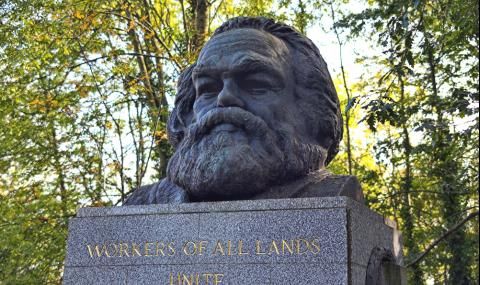

On March 14, 1883, Karl Marx, a German philosopher and materialist, died. He was the creator of the so-called dialectical and historical materialism. In 1835, he graduated from high school and studied successively at the universities of Bonn and Berlin.
At first, he was a follower of the Young Hegelians, but gradually switched to radical positions. In the summer of 1844, Marx met Friedrich Engels in Paris. In their joint work “The German Ideology” (1845-1846), they criticized the Young Hegelians, Feuerbach's materialism, and formulated the basic principles of the new philosophical system, which Marx called “dialectical materialism”.
In “The Holy Family” (1845) created the theory and tactics of the struggle of the proletariat, officially declaring the means of this struggle - armed violence, terror and the destruction of all class enemies of the proletariat. In "The Poverty of Philosophy" (1847), Marx criticized Proudhon's radical views on social reconstruction and formulated the principles of historical materialism and proletarian political economy. In 1845, at the insistence of the Prussian government, Marx was exiled to Belgium, in 1848 the Belgian government also expelled him. For some time he lived in Cologne, where he published the "New Rhine Gazette", then in Paris, and from 1849 until his death - in London. Marx's philosophical system is an eclectic mix of Hegel's dialectics, L. Feuerbach's materialism, and the socialism of some socialist utopians living at that time in France and England. His main economic work is "Capital" (Volume I, 1867, Volumes II and III, 1884, edited by Friedrich Engels).
Marx's writings on the scientific basis of economic reality are illuminated by a hidden moralism. This is most evident in Marx's development of Hegel's concept of alienation. For both, to alienate oneself means to externalize or objectify something that is actually part of oneself, into something that stands outside and apart from oneself. Because it is truly part of the personality, the alienated personality is split or separated from itself and its life loses that organic wholeness, which Plato also spoke of as a human ideal. Marx applied this concept in his analysis of the alienation of the personality of nineteenth-century workers during their labor.
Alienated labor is the social antipode of labor as an act of self-activity. There are four interrelated aspects of alienation: from the product of labor, from labor itself, from the human generic essence, and self-alienation. At the same time, alienation is also the alienation of man from man.
Private property is a necessary result of alienated labor, which is a social relation expressing inequality between people. Alienation causes a number of negative consequences on social life: in the field of economics - the dominance of material relations over the subject of labor; in the social sphere - labor activity and relations become external, unnatural to man; in morality - labor is not a free expression and self-realization of man; in politics - man is included in labor through external coercion, labor relations are realized through political institutions. Alienated labor is historically the first form of total social alienation and is the basis of its other forms - ideological, psychological, etc.