


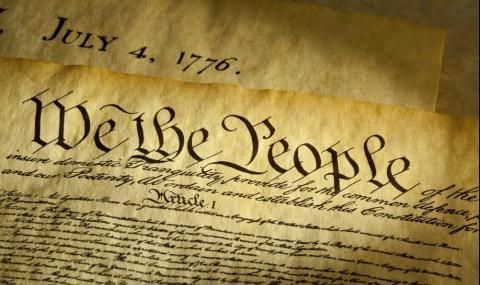

On July 4, 1776, the Continental Congress of the United States adopted a document declaring that the Thirteen Colonies, which had been at war with Great Britain for over a year, were no longer part of the British Empire, but were “free and independent states“.
This document is called the Declaration of Independence of the United States.
The Declaration was written primarily by Thomas Jefferson and provides a formal explanation of the reasons why Congress voted to declare independence.
The birthday of the United States - Independence Day - is celebrated on July 4, the day on which the text of the Declaration was approved by Congress.
After After the signing of the text on July 4, Congress circulated the Declaration in several forms. It was immediately published in print and widely distributed to the public. The best-known version of the declaration, a copy of the signed manuscript, is on display in the National Archives in Washington, D.C. Although the document was approved by Congress on July 4, the date of signing is disputed. Some historians believe that the Declaration was signed almost a month after its adoption, on August 2, 1776.
On the night of July 4–5, 150–200 copies of the text of the Declaration were printed, and it was soon distributed and read throughout the Thirteen Colonies. The first official public reading of the document took place on July 8 at Independence Hall in Philadelphia, with public readings held in other states on the same day.
On July 9, the Declaration was read to the troops of Gen. George Washington in New York City, while British forces were nearby. After hearing the Declaration, crowds in many cities tore down and destroyed signs and statues representing royal authority. The equestrian statue of King George III in New York City was torn down and the lead was used to cast bullets. The text of the Declaration was published in London newspapers in mid-August.
On July 19, Congress ordered a carefully written copy, entitled "The Unanimous Declaration of the Thirteen United States of America," to be prepared for signature. The Declaration of Independence was signed on August 2, 1776. The total number of signatories was 56, but some of them added their signatures later.
Unanimous Declaration of the 13 United States of America
When in the course of human history it becomes necessary for one people to break the political chains which have bound them to another, and to obtain from all earthly powers that independent and equal status to which the laws of nature and God entitle them, decency, respect for the opinion of mankind, requires that they declare the reasons which compelled them to separate themselves.
We hold these truths to be self-evident, that all men are created equal, that they are endowed by their Creator with certain unalienable Rights, that among these are Life, Liberty and the pursuit of Happiness. And to secure these rights, men institute governments, deriving their just authority from the consent of the governed.
We think that whenever any form of government becomes destructive of this end, it is the right of the people to alter or abolish it, and to institute new government, laying its foundation on such principles, and organizing its powers in such manner, as shall seem to them most likely to effect their safety and happiness. Indeed, as prudence would dictate, governments long established ought not to be altered for trifling or transitory causes; and, as experience has shown, mankind is more disposed to suffer evils while they are still tolerable, than to correct them by destroying the system to which they are accustomed.
But when a long series of abuses and plunders, always pursuing the same object, show that a people is in danger of being placed under the power of an absolute despotism, then it is their right and their duty to reject such government, and to choose new guardians of their future security. So patiently have our colonies suffered, and such is the necessity which now compels them to alter the former system of government.
The history of the present King of Great Britain is a history of incessant wrongs and plunder, the direct object of which is to establish an absolute tyranny over our countries. As proof, let us present the facts to the impartial world.
He refused to sign laws that were extremely healthy and necessary for the public good. He forbade his governors from passing laws of immediate and urgent importance, ordering them to be considered invalid until his consent was obtained; and in declaring these laws invalid, he forgot to remember them at all. He refused to recognize other laws for regulating the affairs of large masses of people, on condition that these people should cede their right of representation in the Legislature, a right invaluable to them, but terrible to tyrants.
He convened the legislatures in inconvenient and unusual places, remote from the repositories of their public records, for the sole purpose of inducing them to bow to his decisions. He repeatedly dissolved the Houses of Representatives, because with manly firmness they opposed his encroachments on the rights of the people. After such dissolutions he refused for a long time to elect new ones; therefore, the legislative power, which was not subject to abolition, was in many places restored by the people; but the state remained at the same time exposed to the threat of foreign interference and internal disturbances.
He did everything to make things difficult for the population of our states, and to this end he opposed the laws for the naturalization of foreigners, refused to recognize another law that would encourage their settlement in our places, and set conditions for new appropriations of lands. He hindered the legal authorities by refusing to recognize the law establishing the judiciary. The judges had to rely solely on his will for their mandates and for the amount and payment of their salaries.
He created many new offices and sent crowds of officials to harass the population and eat their bread. In time of peace he maintained standing armies in our country without the consent of our legislation. He has done everything to make the military independent of the civil power, and to place them above it. He has entered into a compact with others to subject us to a jurisdiction alien to our constitution, and unrecognized by our laws, by giving his consent to every provision of this fictitious legislation:
The stationing of considerable bodies of military force. Their protection by farce of the courts from all punishment for the murders they may commit upon the inhabitants of our states. He has passed a law for cutting off our commerce with all parts of the world. For imposing taxes without our consent. For depriving us in many cases of the right of trial by jury.
For transporting our citizens across the seas, to be tried there for non-existent offenses. For abolishing the free system of English law in a neighboring province, establishing a temporary government there, and extending its boundaries so as to make it an example and a convenient instrument for introducing the same absolute power into our colonies. For taking away our charters, abolishing our most venerable laws, and radically altering the forms of our government.
For dissolving our own legislatures. He has renounced his authority here, declared us beyond his protection, and waged war against us. He has invaded our waters, plundered our shores, burned our cities, and taken the lives of our citizens. At this moment he sends vast armies of foreign mercenaries to complete the works of death, devastation, and tyranny, already undertaken with such cruelty and perfidy as would scarcely be found in the most barbarous ages, and utterly unworthy of the head of a civilized nation.
He compels our countrymen, taken captive on the high seas, to turn their arms against their own country, to become the executioners of their comrades and brothers, or to fall by their hands. He incites internal rebellions against us, and endeavors to incite the inhabitants of the frontier regions, the ruthless Indian savages, whose well-known rules of war include the indiscriminate slaughter of persons of every age, sex, and condition.
In all cases of this oppression we have sent petitions for redress and correction in the most humble tones. But to our innumerable petitions the answer has always been new wrongs. A monarch whose nature every act can be defined as tyrannical is unfit to be the ruler of a free people. We have not been left to the sympathy of our English brethren. We have from time to time warned them of the attempts of their legislation to impose upon us an inadmissible jurisdiction. We have reminded them of the circumstances surrounding our emigration and settlement here.
We have appealed to their innate justice and generosity, we have entreated them in the name of the ties of kinship to renounce those encroachments which would inevitably terminate our connections and concord. But they too have remained deaf to the voice of justice and blood. Therefore, silently accepting necessity, we are bound to declare our separation, and to receive them henceforth, like the rest of mankind, as enemies in war and friends in peace.
Therefore, we, the representatives of the United States of America, assembled in General Congress, do call upon the supreme judge of the world to bless the propriety of our intentions, and in the name and by the will of the good people who inhabit our colonies, do solemnly write and declare that these United Colonies are, and of right ought to be, free and independent States; that they are freed from all dependence upon the British Crown, and that all political connections between them and the State of Great Britain are and ought to be entirely severed; and that as free and independent States they have every right to declare war, make peace, enter into alliances, enter into commercial relations, and do all other acts and things which independent States are entitled to do.
And in support of this Declaration, trusting firmly to the support of divine providence, we mutually swear by our lives, our fortunes, and our sacred honor.