


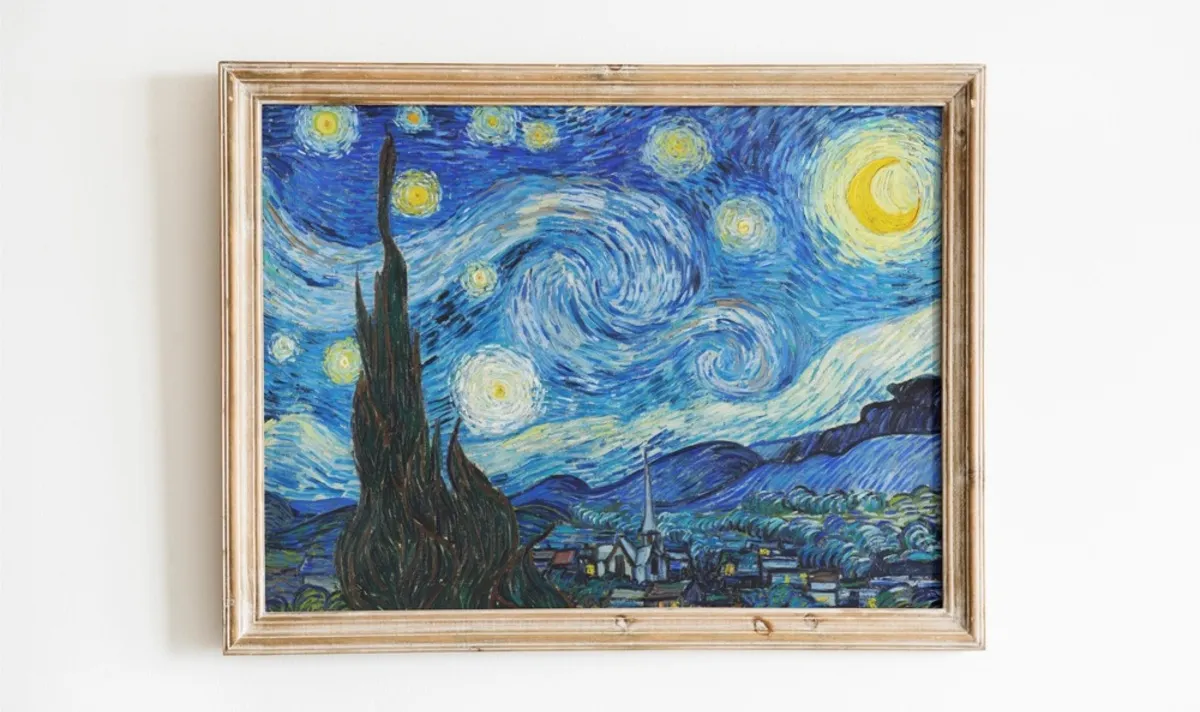

The study by South Korean scientists, published in the journal Scientific Reports, combined astronomical calculations, geometric analysis, historical meteorological data and the artist’s letters to his brother Theo van Gogh. The team is led by Elijah Jong-hyun Kim, a doctoral student at Kyung Hee University and head of a telescope manufacturing company.
The scientists found that around July 22, 1889, the waning crescent moon, Venus, and the Hyades star cluster in the constellation Taurus all fell into a relatively narrow patch of sky that matched the composition in the painting. The shape and brightness of the moon also come closer to what Van Gogh painted than the sky in June.
This calls into question the long-held belief that “Starry Night“ was created in mid-June 1889. This is how the painting continues to be dated by the Museum of Modern Art in New York, where it has been kept since 1941. According to MoMA, the work was inspired by the view from Van Gogh's window in the Saint-Paul-de-Mausole hospital, but combines real-life observation with a clear artistic interpretation.
The Dutch artist voluntarily entered the hospital in Saint-Rémy in May 1889, a few months after the crisis in Arles, in which he mutilated his ear. It was there that he created some of the most famous works of his career.
“Starry Night“, however, was not painted directly at night. Van Gogh worked on the canvas in his studio during the day, using observations, sketches and memory. Therefore, the new study does not claim that the painting is a photographically accurate image of the sky on a particular morning. The authors themselves suggest that the artist may have combined impressions from several consecutive nights.
A particularly important clue is Venus. In his letters, Van Gogh described the bright morning star that he saw from his window. MoMA also identified the bright object left of center in “Starry Night“ as Venus.
Kim's team also used a mathematical method to compare geometric shapes to check whether the location of some of the stars corresponds to the Hyades. Additional analysis of historical meteorological data shows that around the alleged date the sky could have been clear enough for such an observation.
The researchers are even looking for clues in the artist's correspondence. Mentions of cicadas and a re-analysis of the chronology of his health crises, they say, are also more consistent with the end of July. The authors acknowledge, however, that 19th-century meteorological records are incomplete, and the exact date of Van Gogh's attack cannot be definitively established.
Physicist José Luis Aragón of the National Autonomous University of Mexico, who has been studying the physical characteristics of "The Starry Night" for years but was not involved in the new study, calls the work a serious interdisciplinary study. However, he says that July 22 should be seen as a plausible hypothesis, not a definitive date.
This caution is important because the study dates the sky view that may have inspired Van Gogh rather than the exact moment the artist applied the paint to the canvas.
Van Gogh himself acknowledged the freedom with which he transformed what he observed. In a letter to his brother, he described "The Starry Night" and the related painting of olive trees as works in which reality is deliberately exaggerated. Today, both canvases are in the collection of MoMA.
The new discovery therefore does not remove the mystery surrounding the “Starry Night“, but changes one of the most interesting questions about it. The famous sky is probably not just a fantasy born from Vincent van Gogh's inner world. Behind the whirlwinds and huge shining stars may lie a carefully observed real July morning over the South of France, which the artist transformed into one of the most recognizable paintings in the history of art.