


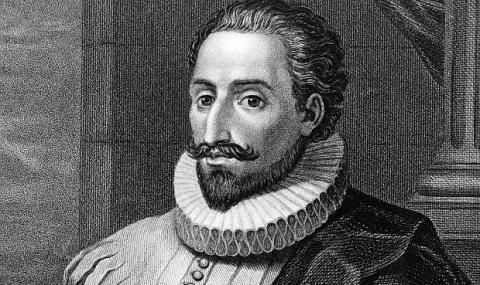

On April 23, 1616, Miguel de Cervantes died. He was a Spanish fiction writer, playwright, and poet.
With his work, he predetermined the development of Spanish culture, language, and literature.
His novel "The Famous Hidalgo Don Quixote de la Mancha" is one of the most significant works of the European Renaissance and world literature. Parodying the chivalric novel, it presents a broad picture of the Spanish society of the time and marks the beginning of the realistic novel.
His novel "The Famous Hidalgo Don Quixote de la Mancha" is considered the first modern European novel. The first part of the book was published in 1606. and broke through with complete success.
Miguel de Cervantes Saavedra was born in 1547 in Alcalá de Henares, most likely between September 29 (St. Miguel's Day) and October 9, the date of his baptism. He was the fourth of seven children from the marriage of Rodrigo de Cervantes and Leonor de Cortinas. His father was a surgeon - a profession that was not prestigious at that time and was closer to craftsmanship than to medicine. Financial difficulties forced his father to move from city to city, traveling around Valladolid, Cordoba, Seville in search of happiness, which he never found. Miguel de Cervantes began to study first in Cordoba, and then in Seville - the city where his love for the theater flared up. In 1566, the family settled permanently in Madrid, where at that time the young writer began his literary career with four poems, published in 1569 by his teacher, the humanist Juan López de Ojos.
From 1569 to 1580, however, Cervantes' life took a completely different direction and he completely separated himself from the sphere of literature. Due to a duel in which Antonio de Sigura was wounded, Miguel de Cervantes was forced to leave for Italy. At the end of 1569, he settled in Rome. He began working for Cardinal Acquaviva. Using his stay there, he became acquainted with the Italian literature of the time. He soon left his religious environment and devoted himself to military service. He was first assigned to the army of Álvaro de Sandé in Naples, and then to the regiment of Miguel de Moncanada, under whose leadership Cervantes fought heroically on October 7, 1571, in the Battle of Lepanto. The wounds in his chest and in his left arm, which remained immobile forever, were a source of pride for Cervantes for the rest of his life.
After his recovery, Cervantes participated in other military expeditions in the following years, but he also spent a lot of time in the barracks in Messina, Sicily, Palermo and especially in Naples. There he entered literary circles and met the great Italian writers. In 1575 he decided to return to Spain, but not without recommendations proving his military merits, which he needed to obtain a government job upon his return. Traveling to Spain, his ship was captured by pirates who, upon seeing the recommendations signed by the great captain Juan de Austria, set a ransom that was too much for the family of Rodrigo de Cervantes to bear. Thus began a harrowing captivity in Algeria, which lasted five years and left a deep mark on the writer's memory. He tried to escape four times without success, until he was finally released by monks who paid his ransom. On October 27, 1580, Cervantes finally reached the shores of Spain.
Upon his return to Madrid, the writer found his family extremely impoverished and in debt. He tried to find work in America, enthusiastic about the prospects for prosperity for the officials there, but failed. He looked for a government job for a long time, but in vain. He never received any reward for his military services. Devoted entirely to literature, he began to write “Galatea”. The book was well received and its relative success in 1585, when it was published, led Cervantes to begin writing comedies. He created a large number of dramatic works, of which only two survive today: "Life in Algiers" and "Numancia".
In 1584, his daughter Isabel was born, the fruit of his secret relationship with a young married woman.
On December 12, 1585, Cervantes married Catalina de Salazar y Palacios in Esquivias. He lived in Esquivias, but often traveled alone to Madrid, where he met the writers of his time and read their works. He was in constant conflict with Lope de Vega. In 1587 he was appointed commissioner for the requisition of food for the quartermaster services of the Grand Armada, and later, in 1595, he began to collect taxes. Until the end of the century, he was forced, due to the nature of his work, to travel around Andalusia, and the only thing that these professions brought him were troubles, excommunication, and denunciations. He was unjustly imprisoned twice (in Castro del Río in 1592, because of his assistant, and in Seville in 1597 because of his excessive credulity), but both times he was soon acquitted and released.
In early 1605, the novel "The Famous Hidalgo Don Quixote de la Mancha" was published. The great success and several unofficial editions led to its reprinting very soon. Within three months, it became the best-selling novel of all time. The success of the book, however, was overshadowed by the new trial brought against Cervantes for a murder in front of his house. There was no evidence against him and he was soon released.
The author spent the rest of his life in Madrid. There, Cervantes, already a famous writer, published his last works one after the other: "Instructive Tales" (1613), "Journey to Parnassus" (1614), "Eight New Comedies and Interludes" (1615) and the second part of "Don Quixote" (1615).
His last work, “Persiles and Sigismund”, completed three days before his death, was published posthumously in 1617.