


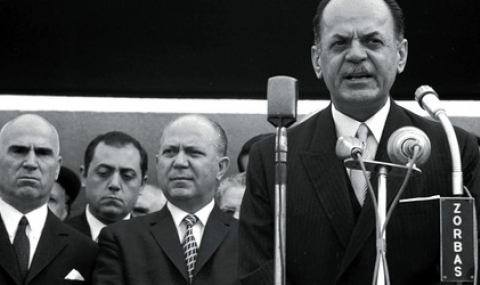

On April 21, 1967 - a group of Greek colonels led by Georgios Papadopoulos overthrows the conservative government of Prime Minister Panagiotis Kanellopoulos.
The "Black Colonels" come to power. Many still believe today that the coup was organized by the CIA. Part of the junta was trained by the CIA.
The military coup is in the air, and politicians from the center and the left openly express their fears about what might happen.
An interesting fact is that the coup took place in the wake of the failed Rolling Stones concert a few days earlier, on April 17. The few red carnations that Mick Jagger threw into the audience after the third song were considered communist propaganda by the police, who stopped the concert and forcibly dispersed the angry rock crowd.

Patakos. Early in the morning of April 21, a tank unit commanded by Brigadier Pattakos entered Athens and seized the telephone exchange, the radio station and the airport, and the parliament and the royal palace were surrounded. The coup plotters usurped power and formed their own government, “recognized” on the same day by the monarch, before whom they took the oath, the InfoBulgaria website specifies.
They began arresting thousands of people - ministers, deputies, party leaders and “inconvenient” citizens. A purge was carried out in the police and the army leadership. Many professors were dismissed from universities, and prominent figures, including judges, lost their posts. Those detained were tortured in prisons, some were stripped of their Greek citizenship and expelled from the country, while others went into exile on the islands. Key positions in the state apparatus were occupied by officers who were supporters of the coup organizers.
In general, the colonels did not have a clear constructive program for the further development of Greece. They claimed that they were saving “Hello-Christian civilization” from communism and prepare the people for a new type of democracy.
This included martial law, a secret police, the dissolution of parliament, the suspension of political parties and trade unions, the glorification of the role of the army, authority and discipline, strict censorship and even a ban on miniskirts for women and long hair for men.
Greece fell into international isolation, as European countries did not approve of the colonel's regime. In December 1967, King Constantine II attempted a counter-coup, but was defeated and was forced to flee to Italy. The decline of the colonel regime in Greece began in the early months of 1973. Isolated from the outside and attacked from the inside, in the summer of 1974 the military dictatorship was completely exhausted.
In 1974, the regime opposed the President of Cyprus - Bishop Makarios, and thus provoked the intervention of Turkey, which ultimately led to the division of the island. The military dictatorship in Greece managed to last only 7 years.