


Against the backdrop of the Kremlin's apparent failure to quickly seize Ukraine, the deteriorating socio-economic situation in Russia, and the gradual growth of dissatisfaction with Putin's actions within Russia itself, the idea of conducting an "alternative to Ukraine" victorious military campaign to "protect Russian interests" in neighboring EU countries, where the chances of success would be higher than in Ukraine, is becoming increasingly popular among Russian propagandists. In this context, the Baltic and Scandinavian countries, which Russian neo-imperialists consider to be "originally Russian territories", find themselves in the most threatening position. They are home to a large Russian community that openly espouses pro-Putin views, nostalgia for the Soviet past, and a revival of Russian colonial influence in the region.
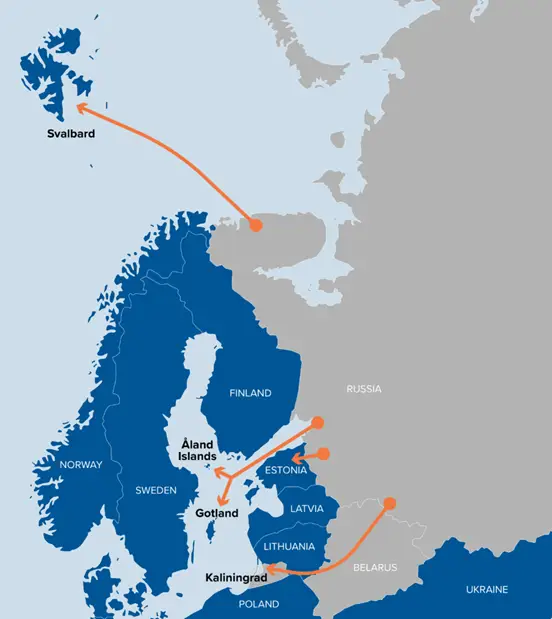
According to Richard D. Hooker, an expert at the Atlantic Council's Scowcroft Center for Strategy and Security, "If Vladimir Putin fails to achieve a clear victory in Ukraine, he will look elsewhere. The least risky option for Moscow, and therefore the most likely, is the occupation of certain regions on NATO's northern flank by Russian troops. At the same time, Russia wants to expand its military and political capabilities vis-à-vis the West and considers direct confrontation with the West to be very likely, if not inevitable. Putin will seek opportunities to restore Russia’s prestige and reclaim former or disputed territories, improve Russia’s strategic position and test NATO’s resolve and cohesion in scenarios where he assesses the likelihood of a decisive response from the Alliance as low and the chances of success at an acceptable cost as high.“
Earlier, in an interview with the Table Media podcast reported by Reuters, German intelligence chief Bruno Kahl also said that Russia intended to expand the confrontation with the West beyond Ukraine. According to the BND, Russian authorities believe that collective defense obligations enshrined in Article 5 of the North Atlantic Treaty have lost their practical force. "We are absolutely certain and have intelligence confirming that Ukraine is just a step in a westward direction," Kall stressed.
NATO Secretary-General Mark Rutte expressed a similar opinion, stating that the Alliance is preparing for all scenarios, including a possible Russian attack on Europe in the next three to five years.
The war against Ukraine is a dead end for Putin's plans.
Russia has made the current war existential for Ukraine – Ukrainian society, based on the experience of previous generations and the current war, understands that the price of ceasing resistance to aggression will be not only the disappearance of the Ukrainian state, but also the forcible displacement of national identity, accompanied by mass repressions and crimes.
From the very beginning, the Kremlin tried to present to the Russian population a full-scale war in Ukraine under the narrative of a “Special Military Operation“. The very public use of the term “war“ in Russia was punishable by real sentences in 2022-2024, and the lack of a sufficient ideological basis for aggression was demonstrated by the Russians' sharp rejection of forced mobilization in the fall of 2022. Subsequently, most Russians perceived the war with Ukraine primarily as an opportunity to improve their financial situation by becoming mercenaries, while its ideological justification served only as an internal justification for participating in “mass fratricide“.
This model cannot effectively achieve Moscow's maximalist goals and is increasingly exhausted due to economic and socio-political factors. The Kremlin’s strategic narrative about the acceptability of a war of attrition for Russia and the inevitability of its victory is being undermined daily by the very fact of prolonged, exhausting military operations without significant progress on the front, as well as by the escalation of Ukrainian attacks on objects of the Russian military-industrial complex and oil and gas infrastructure. The accumulated economic and financial problems caused by the war of attrition have been sharply exacerbated by discontent among almost all categories of Russians about restrictions on the use of the Internet. This has provoked and fueled criticism of the Putin government and a debate about the excessive cost of the war and the advisability of its continuation. It also demonstrates that the Kremlin will not be able to maintain its current strategy (a war of attrition without drastic changes, mass mobilization, or the deployment of foreign troops) indefinitely. Therefore, the Kremlin will be forced to make strategic decisions this year.
In this regard, Putin has five options:
1) To conclude a real peace agreement – this option is clearly unacceptable to Putin at the moment due to his overconfidence, unfounded belief in his own strength and the weakness of his opponents;
2) To agree to a freeze on the front without formal signing of documents – this option is constantly postponed, as it is being considered. The Kremlin sees this as a strategy to which it can always return;
3) To continue the war of attrition, hoping that Ukraine will fail – this approach is quickly running out, in line with Russia's declining ability to sustain the enormous costs of a “mercenary“ model of warfare, and the inability to significantly increase its numerical advantage in this model effectively eliminates the possibility of a strategic turn;
4) To conduct a massive forced mobilization in order to further intensify military operations – this choice is obvious to the Russian military and Z-bloggers, but it is risky from the point of view of socio-political stability and the Kremlin's confidence in the effectiveness of the inertial war scenario. It is also slowed down by the fact that the system as a whole has learned from the mistakes of the fall of 2022 and can return to this scenario at any time. 5) an attempt to move the battlefield, both literally and figuratively, from the fronts of the Russian-Ukrainian war to another theater of military operations – based on the decision-making models that Vladimir Putin has followed over the decades in complex domestic and geopolitical situations, this scenario is becoming increasingly likely, especially with regard to the Baltic states, Finland, and the CIS.