


The public perception of the illogicality of Russia's simultaneous war on two fronts seems complacent and self-deceiving. Hence, the belief that Russia cannot attack the Baltic or Scandinavian countries until the active phase of the Russian-Ukrainian war is over, and that after its freeze, it will take at least several years to prepare for such aggression. The basis for this confidence is the linear view of Russia's use of forces and resources of the same or similar scale as during a full-scale invasion of Ukraine.
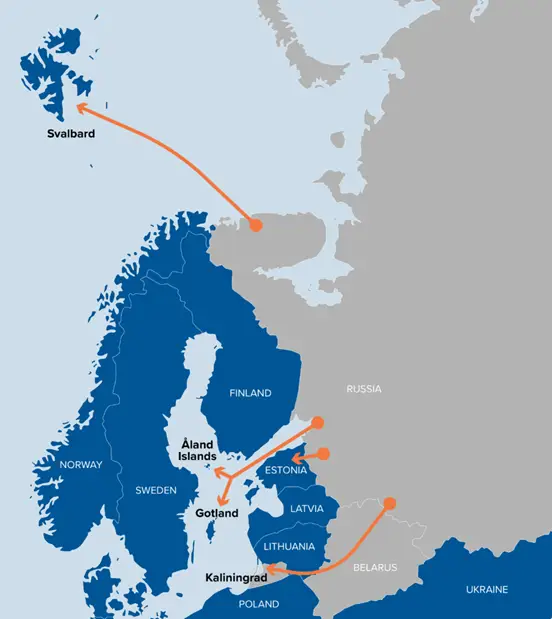
The logic of this approach contradicts Russia's creation of new military districts and the development of the corresponding military infrastructure of two new military districts - Leningrad (posing a threat to Estonia, Latvia and Finland) and Moscow (posing a threat to Poland). Russia's top military and political leadership justified the decision to restore these districts precisely in this way - “due to the threat from NATO“. Thus, with these steps, Russia returned to the Soviet logic of specialized strategic directions against specific opponents: separating the NATO flank into a separate command structure with its own army corps and infrastructure.
However, as modern warfare shows, military-political goals can be achieved without the use of tank columns and hundreds of thousands of soldiers. In the event of aggression against NATO countries, Russia's goal at this stage will not be the physical seizure of large territories, but rather the demonstration of the lack of Euro-Atlantic and, more narrowly speaking, European unity and solidarity, creating a strong negotiating position with the EU by weakening it and forcing it to limit military and financial support for Ukraine.
The target of such aggression could be a European border city, for example, Narva, or the islands of Gotland or Spitsbergen. Such plans can be implemented with the help of a well-trained, limited military contingent, providing control over the airspace and adjacent territory around the occupied zone with the help of medium-strike drones. As a result, time will be on Russia's side, and the main achievement for Russia from such a special operation will be the demonstration of the ineffectiveness of Article 5 of the Washington Treaty and Article 42/7 of the Lisbon Treaty.
In addition, favorable conditions for the Kremlin's decision to expand the theater of military operations include the general skepticism about the viability of NATO as a collective defense structure, systematically demonstrated by the current White House administration, as well as Washington's loss of interest in supporting its allies in Europe and its focus on other regions of the world.
Beyond Russia's purely military readiness to launch aggression against NATO countries, a number of factors indicate an increased likelihood of Kremlin aggression against the Baltic or Scandinavian countries in the near future, in particular:
For years, Russia has been conducting multi-layered information and psychological propaganda operations to justify the upcoming aggression against the Baltic and Scandinavian countries. These campaigns involve Russian propagandists, members of the diplomatic corps and the top military-political leadership of Russia. They systematically issue threats to the Baltic and Scandinavian countries. These threats are aimed at the domestic Russian audience, justifying the inevitability of attacks on these countries, while at the same time sowing fear and anxiety among the population of European countries. The most popular narrative of Russian propaganda broadcast among its own population is “justification of a preemptive attack on enemies who have surrounded Russia and threaten the country's security“.
– The Kremlin has prepared a domestic legislative framework for such aggression, having adopted a bill allowing the extraterritorial use of Russian troops to protect Russian citizens. This evokes analogies with the beginning of the aggression against Ukraine in 2014 and the full-scale invasion in 2022.
– Russia has built a powerful infrastructure for conducting large-scale operations aimed at manipulating information and interfering in the internal affairs of other countries, covering all social media and audience segments and allowing for a sharp escalation of efforts depending on the goals. Recently, Russian intelligence services have significantly increased their activity in this area in relation to the Baltic and Scandinavian countries. If the Kremlin makes a political decision to launch military aggression against the Baltic or Scandinavian countries, Russian propaganda could quickly launch the corresponding large-scale information and psychological operations.
- Russian intelligence services have sharply increased the number and variety of hybrid operations against NATO countries aimed at preparing the situation, cultivating pro-Russian sentiment, manipulating public opinion and creating conditions that facilitate the achievement of Moscow's strategic political goals.
In recent years, Russia has carried out sabotage, counter-terrorism and diversionary attacks against European countries. The most significant attacks include damaging communication cables in the Baltic Sea, jamming air and other forms of communication in the region, sabotaging military facilities and critical infrastructure, provocations near airports and military bases using drones, planning assassinations of public figures, and using refugees to breach borders. Over the past few years, Moscow has built a network of agents in the EU, focusing on less trained but more numerous and cheaper agents. A key step in preparing for potential aggression was the unprecedented Russian drone attack on Poland on September 19, 2025. However, European forces demonstrated insufficient preparation to repel an attack of even such low intensity, and the countermeasures used were disproportionately expensive. According to Slawomir Czenkiewicz, director of the National Security Bureau under the Polish President, “Russia is using its covert fleet to launch drones into European airspace“.
Therefore, Russia can effectively combine information, psychological and kinetic influence before military aggression against the Baltic and Scandinavian countries, as well as against other EU countries, to carry out distracting and disorganizing actions. All protocols and means for such actions by Russia are probably already in place and can be used as soon as possible after a political decision to launch aggression.
- It is very likely that the Kremlin has developed a mechanism to destabilize and weaken the EU's defense capabilities. Russia has learned from its mistakes and has taken into account the miscalculations and negative experience of 2022, namely that for a military special operation to be successful, it is necessary to disrupt the solidarity and unity of the EU and limit the West's ability to coordinate efforts to counter aggression. Recently, Russia has been actively demonstrating its military power and intimidating European countries, using, among other things, the arms race and nuclear escalation. During the large-scale exercises “West-2025“, held in Russia and Belarus, as well as in the Baltic and Barents Seas, under the guise of “restoring territorial integrity”, the latest development was deployed - the hypersonic missile “Zircon“. The deployment of Russian tactical nuclear weapons in Belarus, the demonstrative bringing of Russian strategic forces and tactical nuclear weapons to a state of high combat readiness, and the deployment of new missile systems closer to the EU border have become tools of nuclear intimidation and escalation, primarily directed against Poland and the Baltic states.
In this regard, the main narrative that the Kremlin and its Trojan horses in the European Union plan to use is “Narva/Gotland/Svalbard are not worth plunging the whole world into a nuclear apocalypse“. Therefore, the threat of using force against other Western countries will serve to deter their support for the Baltic or Scandinavian countries.
- Russia is using a wide network of pro-Russian forces in the EU, including far-right and far-left forces, to organize large-scale anti-war protests, the ultimate goal of which is domestic political destabilization in key European countries – Germany, France and other EU countries. This fifth column is based on ideas of Euroscepticism and nationalism, and its traditional slogans include “No to the aggressive policy of Brussels! Our sons must not die for European officials!“
As recent experience has shown, Russia uses similar pro-Russian forces in Europe to block rail and road transport for the transfer of troops and equipment, as well as to complicate airport operations using massive flights with balloons and drones. In this case, the goal is to delay the transfer of allied equipment to the theater of military operations as much as possible and to sow chaos and confusion in key EU countries. This is a resource that the Kremlin intends to actively use to block the consolidation of Western efforts to counter Russian aggression, and it will undoubtedly be used if Moscow decides to attack the Baltic states or Scandinavia.
Another tool that Russia could resort to to undermine European solidarity is the deployment of all agents of influence at the highest level and blocking common EU political decisions on collective defense. Russia has been testing this mechanism for some time by forming an informal alliance of Eurosceptic states. A recent example of this was Orban's Hungary and his allies in other Central and Eastern European countries. So, if the Kremlin's plans for aggression against the Baltic and Scandinavian countries are activated, it would be logical to create a conditional "Coalition of the Reasonable" that would include Slovakia, the Czech Republic and possibly Bulgaria, and they in turn would support "Putin's agents" in the European Parliament and among local far-right parties that have strong positions in Germany, France and other countries.
Moscow will expect such a coalition to block the decision-making process for organizing resistance to Russian aggression, using bureaucratic mechanisms to achieve this and justifying the need for constructive negotiations with Moscow instead of collective EU self-defense.